
Retail Media: Making Your Venue Footfall Pay
A shopping centre concourse, supermarket entrance or retail park car park already has something advertisers want: an audience with intent. Retail media gives venue operators a structured way to turn that attention into advertising income, while giving brands a more relevant place to reach customers close to a buying decision.
For property teams, facilities managers and marketing leads, the opportunity is not simply to install more screens. It is to create a dependable advertising environment that works for visitors, retailers and commercial partners alike. The quality of the display, its location, the supporting infrastructure and the way campaigns are managed all influence whether the investment becomes a useful revenue stream or an underused asset.
What retail media means for physical venues
Retail media began as advertising sold through a retailer’s own channels, particularly online marketplaces and customer data. In physical spaces, the principle is equally straightforward: brands pay to communicate with shoppers through assets owned or controlled by the retailer or venue operator.
Digital screens are a major part of this model. They can carry brand campaigns, promote tenants, support seasonal activity and share timely visitor information from the same network. Unlike printed posters, content can be scheduled by time of day, location, audience profile or campaign priority. A breakfast offer can run during the morning commute; family leisure messaging can appear around school holidays; a retailer promotion can be changed without a reprint or a site visit.
That flexibility does not mean every screen should be sold to outside advertisers. In many locations, the best return comes from balancing paid media with communications that improve the visitor experience. A centre may need to prioritise wayfinding, event information and safety messaging at certain times. A well-planned retail media estate makes space for both commercial and operational needs.
Why screen quality affects advertising value
Advertisers are buying attention, but they also expect their creative to be presented properly. A dim, poorly positioned or unreliable display weakens the campaign and reflects badly on the venue selling it. This is especially relevant for outdoor and semi-outdoor sites, where daylight, weather, viewing distance and dwell time must all be considered before specifying a screen.
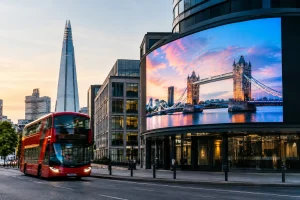
Brightness and pixel pitch need to suit the setting. A close-viewed digital totem in an indoor mall requires a different specification from a large-format roadside billboard seen by drivers and passengers at distance. Selecting a product on headline resolution alone is rarely the right approach. Viewing angles, ambient light, cabinet construction, heat management and service access matter just as much over the life of the installation.
Reliability also has a direct commercial effect. When a display is unavailable, an advertising slot cannot be delivered. Repeated outages make it harder to retain advertisers, justify premium rates and build confidence among tenants. Venue operators should therefore look beyond the initial screen price and assess warranty cover, replacement-part availability, remote monitoring and the practical response available if a fault occurs.
Build the retail media proposition around the site
The strongest retail media programmes start with the physical environment, not a generic rate card. Footfall alone is useful, but it does not tell the full story. A busy route where people pass quickly has different advertising potential from a food court, queueing area or waiting lounge where audiences have time to absorb a message.
A site survey should consider traffic flow, typical pause points, sightlines, mounting positions, available power and data connectivity. It should also account for planning requirements, landlord approvals and structural considerations. These details can seem separate from advertising sales, yet they determine whether a display is visible, safe, maintainable and capable of running consistently.
There is also a judgement to make about scale. One large, high-impact screen at a natural focal point can be more valuable than several smaller displays placed where they compete with surrounding clutter. Conversely, a network of strategically located screens may offer advertisers frequency and allow messages to be tailored to different zones. The right answer depends on the venue, its audience and how the inventory will be sold.
A practical route from screen to revenue
Before commissioning a digital display network, define what success will look like in commercial as well as technical terms. Is the primary aim to generate third-party advertising revenue, add value for existing tenants, reduce print costs, or improve communications across a multi-site estate? These objectives affect the screen locations, content rules and sales approach.
A sensible plan should establish the available advertising inventory, reserving enough capacity for venue messaging and urgent notices. It should set standards for creative approval, campaign duration and frequency, particularly where multiple advertisers share the same screen. In a premium retail environment, content quality matters. Overcrowded playlists, inappropriate creative or constant message changes can reduce the perceived quality of the space.
The sales model needs similar care. Some operators sell campaigns directly to tenants and local businesses. This can work particularly well where businesses want proximity to a specific centre, business park or transport interchange. Larger estates may work with a media sales partner, which can broaden advertiser access but reduces the operator’s share of revenue. A hybrid arrangement is often practical: retain priority inventory for tenants and venue activity, while making surplus capacity available through external sales channels.
Content management should be straightforward for the people responsible for it. The chosen platform needs appropriate scheduling controls, user permissions and remote access, but it should not create unnecessary administrative work. Clear ownership is essential. Decide who approves creative, who uploads campaigns, who monitors proof of play and who responds when a screen or connection needs attention.
Measuring value beyond impressions
Retail media is increasingly judged on measurable outcomes, but measurement should be realistic for the environment. Online retail media can often connect an advert to a transaction at an individual level. Physical venues have different constraints, particularly around privacy and data use.
Footfall counts, dwell-time estimates and screen operating reports provide a useful foundation. Campaign performance can then be assessed through retailer redemption codes, promoted-product sales, event attendance, QR-code activity where appropriate, or uplift during a defined campaign period. No single measure tells the entire story, so advertisers should be clear about what can genuinely be reported before a campaign is sold.
Proof of play is particularly important. It confirms that a creative was scheduled and displayed as agreed, helping the operator maintain transparent relationships with advertisers. For multi-location campaigns, reporting can show where and when each asset ran, making the estate easier to manage and the proposition easier to renew.
The trade-offs that deserve attention
Retail media can create new income, but it must not make a venue feel less welcoming. Excessive brightness, intrusive sound, unsuitable creative or screens placed without regard for architecture can undermine the very environment that attracts visitors. Good practice means matching display format and content density to the character of the location.
There is a financial trade-off too. A low initial purchase price can be appealing, particularly when budgets are under pressure. However, displays installed in demanding public environments need to withstand long operating hours and be serviceable over time. The cost of downtime, replacement equipment and disrupted campaigns should be weighed against the capital saving.
For larger or more complex schemes, an end-to-end supplier can reduce risk by taking responsibility for survey work, bespoke screen design, installation, commissioning and ongoing support. As a British manufacturer with more than 45 years of experience, LEDsynergy Billboards works with clients to specify digital advertising systems around the site and commercial objective rather than forcing a standard product into every application.
The most successful retail media installations do not treat the screen as a standalone purchase. They treat it as part of a well-run venue: visible when it needs to be, useful to visitors, credible to advertisers and supported properly after installation. Get those fundamentals right, and each impression has a better chance of becoming lasting commercial value.

I would recommend LED Synergy to anyone considering purchasing an LED sign. We have had so many compliments since it was installed and it has been a valuable asset.
Tom Hughes
OSI Food Solutions