
LED Advertising Trends UK Sites Should Watch
A digital billboard beside a busy road, outside a retail park or within a station has only seconds to earn attention. The most relevant LED advertising trends are therefore not simply about bigger screens or more dramatic creative. They are about making every display more useful, more dependable and better suited to the setting in which it operates.
For property operators, venue managers and commercial teams, the right investment begins with the site itself: who passes through it, at what speed, in what light, and for what purpose. A well-specified LED screen can modernise communications, create advertising revenue and give a location a stronger public presence. A poorly planned one can become an expensive compromise.
LED advertising trends are becoming site-specific
The era of treating every digital screen as a standard advertising board is fading. Buyers increasingly want displays designed around the viewing distance, dwell time, surrounding architecture and commercial objective of a particular location.
At a roadside location, clarity at speed is the priority. This may mean a larger pixel pitch, bold creative and short messages that can be understood at a glance. In a shopping centre or leisure venue, viewers are closer and have more time. Here, a finer-pitch display can support detailed promotions, event information, wayfinding and premium advertising inventory.
This shift matters because specification affects both capital cost and long-term performance. The smallest pixel pitch is not automatically the best choice, nor is the highest brightness level. Correctly matching the screen to its real-world viewing conditions helps control costs while delivering a result that genuinely works.
Content is becoming more responsive, not just more frequent
One of the most practical trends is the move towards content that reflects time, place and audience behaviour. Rather than running the same campaign repeatedly all day, screen operators can schedule messages around opening hours, commuter flows, events, weather or available stock.
A business park may show visitor information in the morning, occupier communications at lunchtime and local advertising later in the day. A leisure venue can switch from ticketing messages before a performance to food and drink offers during an interval. The screen becomes a working communications asset, not a static piece of infrastructure with changing pictures.
This does not mean every display requires complicated automation. In many cases, a clear content plan and straightforward scheduling software are enough. The key is to choose a content management approach that the on-site team can use confidently, with appropriate training and support available when required.
Creative is adapting to the speed of the environment
Digital creative is also becoming more disciplined. On a large LED billboard, the best campaigns do not try to reproduce a printed poster word for word. They use high contrast, readable type, simple imagery and one clear call to action.
Motion can be highly effective, but it must serve the message. Fast, distracting animation may look impressive in a studio yet be difficult to absorb from a moving vehicle or in a crowded concourse. Good content is designed for the screen’s location, not merely resized to fit it.
3D LED displays are being used with greater purpose
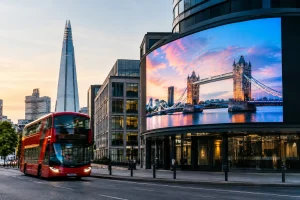
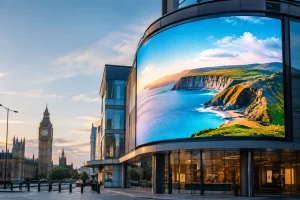
Forced-perspective 3D billboard content has drawn considerable attention, and for the right site it can create a memorable moment that encourages social sharing. It is particularly suited to prominent urban locations, retail destinations and leisure environments where audiences can view the display from a known angle and have time to stop.
However, 3D is not a replacement for clear everyday communication. It relies on carefully considered screen geometry, viewing position and specialist creative production. A standard full-colour LED screen may provide better commercial value where the priority is flexible advertising, information display or regular tenant messaging.
The strongest projects make this decision early. If 3D capability is part of the ambition, it should inform the physical design and content strategy from the outset rather than being treated as an afterthought.
Energy performance is moving up the buying agenda
Energy use has become a more prominent consideration for UK organisations managing public-facing assets. LED technology is efficient compared with many older display methods, but energy performance still depends on screen size, brightness settings, operating hours and the quality of the underlying components.
Modern systems can adjust brightness in response to ambient light conditions. This supports visibility on bright days while reducing unnecessary output after dark. Scheduled switch-off periods and sensible operating profiles can also make a meaningful difference, particularly across multi-site estates.
There is a balance to strike. Cutting brightness too far can reduce readability and weaken the advertiser’s investment. The goal is not the lowest possible power figure on a specification sheet, but an installation that remains visible, safe and commercially effective while operating responsibly.
Reliability is becoming part of the advertising proposition
An advertising screen that is blank, uneven or difficult to update does not only create a maintenance issue. It can affect revenue, tenant confidence and the perceived quality of a venue. For this reason, buyers are looking beyond headline technical figures and asking more searching questions about build quality, access, warranties, service arrangements and component availability.
Outdoor screens must cope with changing weather, temperature variation, wind loading and long operating hours. Indoor systems face different demands, including continuous use in bright retail settings, restricted installation access and the need to integrate neatly with existing finishes. In either case, a screen should be engineered for its environment rather than selected solely from an off-the-shelf catalogue.
This is where a proper site survey remains essential. It establishes the practical realities before manufacture and installation: power provision, structural considerations, data connectivity, access equipment, viewing angles and maintenance requirements. Addressing these points early reduces the risk of delays and costly changes later.
Remote monitoring supports faster response
Networked LED displays make it easier to monitor screen performance and manage content without visiting every site. For organisations with multiple venues, this can save time and help maintain consistency across an estate.
Remote access is valuable, but it should be paired with clear accountability. When an issue occurs, the important question is not only whether a system can report it, but who will diagnose it, provide advice and attend site if necessary. Reliable support is especially valuable for screens that carry paid campaigns or time-sensitive public information.
Digital billboards are becoming revenue infrastructure
More site owners are assessing LED screens as assets that can generate income, rather than as a marketing cost alone. Retail parks, commercial developments, transport environments and leisure destinations can offer advertising space to nearby businesses, national brands, suppliers and event partners.
The commercial model depends on the location. A high-footfall shopping centre may sell a premium package combining digital screen exposure with other on-site media. A business park might prioritise occupier communications while reserving selected slots for local advertisers. Some locations benefit from a single sponsor, while others need the flexibility to run multiple campaigns throughout the day.
Before selecting a screen, it is worth defining what success looks like. Is the purpose to improve visitor information, support in-house promotions, attract third-party advertising revenue, or achieve all three? The answer influences screen size, placement, software needs and the way advertising inventory is managed.
Installation quality remains the trend that never changes
Technology advances quickly, but the fundamentals of a successful LED project remain remarkably consistent. The screen must be correctly specified, manufactured to a dependable standard, installed safely and commissioned properly. It must also be supported after handover by people who understand the system and the site.
A consultative supplier can help translate a commercial ambition into a practical system – including display format, cabinet design, brightness, mounting method, connectivity and content workflow. This is particularly important where the installation is bespoke, the location presents access challenges or the screen needs to fit an existing building design.
At LEDsynergy Billboards, this practical approach is central to how projects are delivered. With British-built systems and decades of industry experience, the focus is on getting the specification right first time and providing support that continues long after the screen is switched on.
The most valuable LED advertising trends will always be those that improve the experience for viewers and the return for operators. Start with the audience, the environment and the job the screen needs to do. The technology should then follow with a solution built to perform for years, not just make an impression on installation day.

I would recommend LED Synergy to anyone considering purchasing an LED sign. We have had so many compliments since it was installed and it has been a valuable asset.
Tom Hughes
OSI Food Solutions