
Digital Billboard Trends 2026 for UK Sites
A digital billboard at a busy retail park, station approach or leisure venue has only seconds to earn attention. That is why the most meaningful digital billboard trends 2026 are not simply about brighter screens or more ambitious creative. They are about making a display work harder for the site, the audience and the people responsible for keeping it operational.
For UK property operators, venue teams and advertisers, the best projects will combine visual impact with dependable engineering, sensible running costs and content that responds to real conditions. The technology is moving quickly, but the fundamental buying question remains familiar: will this screen deliver value reliably for years, not just look impressive on installation day?
Digital billboard trends 2026: value beyond visibility
Digital out-of-home has matured from a replacement for printed posters into an active communications asset. A well-positioned screen can sell advertising space, promote tenants, guide visitors, support events and communicate urgent messages from the same installation. In 2026, buyers are increasingly assessing that wider commercial and operational return before they assess headline pixel pitch.
This changes the project brief. Rather than specifying a screen in isolation, decision-makers are considering footfall patterns, viewing distances, dwell time, local planning requirements, power availability, network access and who will manage content after commissioning. A display in a shopping centre may need to balance campaign advertising with wayfinding and retailer messaging. A roadside billboard may prioritise legibility at speed, resilience in poor weather and remote monitoring.
The strongest installations are designed around these realities from the outset. An apparently lower-cost, standard product can become expensive if it is poorly suited to the location, difficult to service or unable to meet the required brightness and viewing angle. Bespoke design is not about adding complexity for its own sake. It is about avoiding compromises that limit performance.
Smarter content scheduling becomes standard practice
Static playlists are giving way to planned, data-informed scheduling. This does not mean every digital billboard needs a complicated automation programme. It means content should reflect when and where people see it.
A leisure venue, for example, can promote family activities earlier in the day, food and drink offers in the late afternoon, and event information before evening arrivals. A business park can prioritise visitor instructions at peak arrival times and tenant communications during the working day. Advertising inventory can then be organised around the highest-value periods rather than sold as a one-size-fits-all slot.
Weather, time, local events and footfall data can all influence the message. Used well, these inputs make campaigns more relevant without making the screen feel over-managed. Used badly, they produce frequent changes that distract rather than inform. The priority should always be a clear message, visible at the intended viewing distance, with sufficient time on screen to be understood.
Creative is being designed for the actual environment
The move towards short, bold creative will continue. Large type, high contrast, minimal copy and a single clear call to action remain more effective than trying to recreate a print advert on a digital display. Motion can add stopping power, but it should support the message rather than compete with it.
This is particularly relevant near roads, transport hubs and shared public spaces. Content must be appropriate for the viewing context and should not create unnecessary distraction. In many cases, a restrained transition and a well-composed image will outperform an elaborate animation.
For multi-site operators, centrally managed templates are proving valuable. They protect brand consistency while allowing local teams to update opening times, offers, tenant details or event notices. The practical benefit is speed without losing control.
3D digital billboards will be selective, not universal
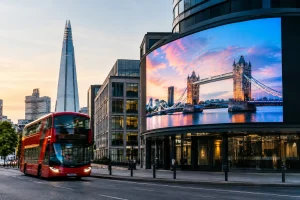
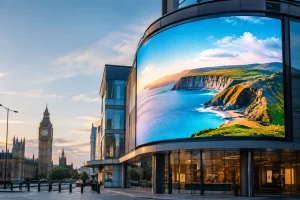
Anamorphic 3D displays have become a highly visible part of digital out-of-home. When the screen geometry, viewing position and creative are carefully matched, they can generate genuine attention and social sharing. For landmark locations, destination retail and major brand activations, that impact can be commercially compelling.
However, 3D is not a default answer. It relies on a defined viewing point and specialist creative, and it may not suit sites where audiences approach from many angles or move quickly past the screen. It can also place greater demands on the structure, content budget and technical planning.
For many locations, a high-quality conventional LED billboard with well-managed content will offer the better return. The decision should follow site analysis, not fashion. If a 3D format supports the commercial objective and physical setting, it can be exceptional. If it does not, a bespoke flat or curved display may be the more effective long-term choice.
Reliability and maintainability move up the buying agenda
The most expensive screen is often the one that cannot be used when it matters. As digital signage becomes more central to advertising revenue and site communications, uptime is no longer a technical detail. It is a commercial requirement.
This is driving greater attention to cabinet design, ingress protection, heat management, component quality, front or rear service access and the availability of replacement parts. Outdoor UK installations must withstand rain, wind, temperature changes and prolonged daily operation. Indoor displays have different demands, but still need appropriate ventilation, safe access and dependable control systems.
Remote monitoring is also becoming a more expected part of the specification. It allows faults, connectivity issues and abnormal operating conditions to be identified early, often before a site team notices a problem. That does not remove the need for responsive on-site support, but it can reduce downtime and make maintenance more planned.
Buyers should ask clear questions before committing: who manufactured the screen, who installs it, who supports it after handover, and what happens if a module or power component fails? A complete answer matters more than a broad warranty statement.
Energy efficiency needs an honest assessment
Energy use will remain under scrutiny in 2026, particularly for larger outdoor networks and organisations with ESG targets. Modern LED technology, intelligent brightness control and sensible operating schedules can reduce consumption significantly. A screen does not need to run at maximum brightness at night, in poor light or when the site is closed.
Yet efficiency should be considered alongside visibility. Under-specifying brightness may save energy on paper while leaving the display ineffective in direct sunlight. Equally, operating an overly bright screen after dark can waste power, affect neighbouring properties and undermine the viewing experience. Light sensors and properly configured brightness controls provide a more balanced approach.
Whole-life cost is the useful measure. It includes power use, expected operating hours, maintenance access, potential revenue, screen lifespan and the cost of disruption if the display is off line. The cheapest purchase price rarely tells that full story.
Planning, safety and local context remain essential
Digital billboard trends in 2026 will not remove the need for careful UK planning and site preparation. In fact, as displays become more capable, authorities and stakeholders are likely to look more closely at brightness, operating hours, visual amenity, road safety and the character of the surrounding area.
Early site surveys help identify structural requirements, foundations, cable routes, electrical supply, drainage, access equipment and sightlines. They also highlight practical constraints such as neighbouring residences, conservation considerations or restrictions around highways. Addressing these details early is usually faster and more cost-effective than redesigning after an application or installation issue.
Content policies should be considered at the same time. A landlord, local authority or transport operator may need approval processes, restrictions on certain advertising categories, and a route for urgent public information. A screen is easier to manage when these rules are agreed before commercial campaigns begin.
Connected screens need sensible security
As more displays are connected to content management platforms, networks and external data feeds, cyber security becomes part of the asset management plan. The risk is not limited to a screen going blank. Unauthorised content, interrupted advertising schedules and loss of operational control can damage revenue and reputation.
Good practice includes controlled user permissions, strong passwords, secure remote access, software updates and a clear division of responsibility between the display supplier, IT team and content operator. The right level of protection depends on the network and application, but it should be designed into the project rather than added as an afterthought.
This is another reason to choose an experienced supplier that can coordinate screen hardware, connectivity and operational support. LEDsynergy Billboards approaches these projects as complete installations, helping clients make informed choices before the screen is built and long after it is commissioned.
What to prioritise when planning a 2026 installation
The technology may be evolving, but the decision process should stay disciplined. Start with the result the screen must achieve: advertising revenue, higher tenant visibility, better visitor communication, a more distinctive destination, or a combination of these. Then assess the physical site and the audience before selecting display size, resolution, brightness and format.
Allow enough time for survey work, approvals, structural design and content planning. Ensure the display can be safely accessed and supported, not merely installed. Finally, assess service provision with the same care as the screen specification. A reliable partner should be transparent about what is included, what is site-dependent and how support will work in practice.
The most successful billboard projects in 2026 will not chase every new feature. They will invest in the right screen, in the right location, with a clear commercial purpose and a support plan that keeps it performing day after day.

I would recommend LED Synergy to anyone considering purchasing an LED sign. We have had so many compliments since it was installed and it has been a valuable asset.
Tom Hughes
OSI Food Solutions