
How to Manage Digital Billboard Downtime Well
A digital billboard that goes dark at 5pm on a busy Friday does more than interrupt a campaign. It can lose advertising income, weaken a venue’s presentation and create an immediate support issue for the facilities team. To manage digital billboard downtime effectively, operators need a plan that starts well before a fault appears – with the right screen specification, monitoring arrangements and supplier accountability.
Downtime cannot always be eliminated. Outdoor displays operate through changing weather, heavy usage, power fluctuations and network dependencies. What matters is how quickly an issue is identified, how accurately it is diagnosed and whether there is a clear route to restoration. A well-designed digital billboard system makes that process faster and less disruptive.
Why downtime needs commercial attention
For an advertising-supported screen, every period offline has a measurable cost. Campaign commitments may need to be extended, proof-of-play records may be affected and media buyers may question the reliability of the site. In a retail, transport or leisure setting, the impact can extend beyond advertising. A blank screen can leave visitors without wayfinding, live information or promotional messaging at the point it is most needed.
There is also a reputational consideration. A screen showing distorted content, a frozen image or visible failed modules is often more damaging than a screen that has been taken offline while a repair is arranged. The right response depends on the fault, the location and the screen’s role. A prominent roadside billboard demands a different escalation threshold from an internal display used for occasional promotions.
This is why digital signage should be treated as operational infrastructure rather than a one-off marketing purchase. The installation, control system, connectivity and support arrangements must work together over the life of the screen.
Build downtime prevention into the original specification
The most effective way to reduce downtime is to make sensible technical decisions before installation. A display designed only around the initial purchase price can become expensive if its components are difficult to access, unsuitable for the environment or unsupported when faults occur.
Specify for the location, not just the image
Outdoor digital billboards must be engineered for their actual surroundings. This includes expected viewing distance, ambient light, exposure to rain and wind, local temperatures, pollution, salt air where relevant, and the available electrical infrastructure. Brightness, ingress protection, thermal management and cabinet construction all influence reliability.
For example, excessive heat can shorten component life and lead to intermittent faults. A screen installed where direct sunlight is intense may need a different brightness and cooling approach from one positioned on a sheltered commercial estate. Similarly, an indoor screen in a shopping centre may face lower weather exposure but much longer daily operating hours.
There are trade-offs. Higher brightness and more intensive cooling may be necessary for visibility in demanding locations, but they also increase energy use and place greater importance on planned maintenance. The correct answer is rarely a standard product selected from a list. It comes from a proper site survey and a specification matched to the job.
Plan access before the screen is commissioned
A repair can only be completed quickly if technicians can safely reach the equipment. Access arrangements should cover the front or rear of the display, the control equipment, power distribution, data connections and any external communications cabinet.
For elevated roadside or building-mounted installations, access equipment, landlord permissions and traffic management may affect repair times. These practical issues should be discussed at the outset, not discovered when a module needs replacing. Good installation planning protects both maintenance speed and future costs.
Keep critical components serviceable
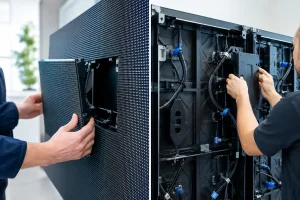
Modular LED construction is valuable because individual sections can usually be replaced without removing the whole display. However, operators should confirm how replacement modules are matched, what lead times apply and whether the design allows safe replacement without compromising surrounding components.
The same principle applies to receiving cards, power supplies, media players and network equipment. Using proven, serviceable components with a clear support route reduces uncertainty when a fault occurs. Bespoke does not mean difficult to maintain. It should mean the system has been designed around the site and its operational needs.
Monitor the screen and its supporting systems
Many billboard faults develop gradually. A rising cabinet temperature, unstable connection or declining power supply may be visible in system data before the audience notices a problem. Remote monitoring helps operators move from reactive repair to early intervention.
The monitoring arrangement should cover more than whether the screen is switched on. Where appropriate, it should report display status, cabinet temperature, power condition, network connectivity and content playback. Alerts should reach a named person or support team who knows what action to take, especially outside standard office hours.
Content management also deserves attention. Sometimes a screen is physically healthy but appears blank because a scheduled campaign has ended, a media player has stopped receiving content or a publishing setting has been changed. Separating content faults from hardware faults prevents unnecessary site visits and speeds up resolution.
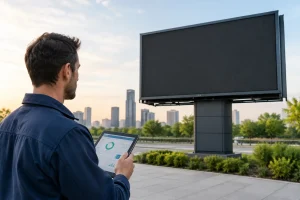
A simple operational check is still worthwhile. For high-value locations, a member of the site team should visually inspect the display at defined intervals. Remote data is useful, but it may not identify every visible issue, such as a colour inconsistency or a partially obscured screen.
Create a clear response plan for digital billboard downtime
When a problem is reported, the first objective is to establish what has failed. Is the entire display offline, a section of LED affected, content frozen, brightness incorrect, or the network unavailable? A short fault-reporting process makes a significant difference.
Site teams should record the time the issue was first seen, the display’s condition, any error messages, recent power or network events, and photographs or video where it is safe to obtain them. This information gives a support engineer a useful starting point and can often avoid delay.
The response plan should define who contacts the display supplier, who can approve attendance, who provides site access and who communicates with advertisers or internal stakeholders. In multi-site estates, uncertainty over responsibility is a common cause of avoidable downtime.
It is sensible to agree priorities in advance. A complete outage at a premium advertising location may require immediate escalation, while a minor fault in a less prominent part of the display may be scheduled into the next service visit. Neither approach is automatically right or wrong. The decision should reflect safety, contractual obligations, audience impact and the availability of suitable repair access.
Protect advertising commitments while repairs are arranged
A practical contingency plan helps preserve commercial relationships. If a screen cannot show a booked campaign, the operator may be able to extend the campaign period, provide equivalent display time at a later date or use another available screen within the estate. The appropriate arrangement depends on the advertising agreement and the nature of the outage.
Accurate proof-of-play records are essential here. They provide a fair basis for discussions with advertisers and help distinguish between a short interruption and a longer loss of delivery. For internal communications, keep stakeholders informed with plain language: what has happened, what is being done and when the next update will be provided.
Avoid promising a repair time before the cause is confirmed. A network reset may resolve an issue within minutes; a component replacement may require a site visit and access planning. Clear, realistic communication is more valuable than an optimistic estimate that cannot be met.
Use planned maintenance to reduce repeat faults
Planned maintenance is not simply a warranty requirement. It is an opportunity to identify wear, clean critical areas, check fixings and connections, review cooling performance, and confirm that the screen is operating as intended.
The frequency depends on the installation. A high-traffic outdoor billboard exposed to dirt, moisture and seasonal temperature changes will generally need closer attention than a protected indoor display. Screens operating long hours, or carrying revenue-critical advertising, also justify a more proactive schedule.
Maintenance visits should result in useful records. Note the work completed, components inspected or replaced, observations about the site environment and any recommendations for the operator. Over time, these records help identify recurring patterns, such as repeated network interruptions or heat-related alarms, before they become major failures.
It is also worth reviewing the content system during routine checks. Software updates, expired credentials, changes to local IT policies and altered network settings can all create avoidable interruptions. The display supplier, site IT team and content operator should understand where their responsibilities begin and end.
Choose support that is accountable
The quality of post-installation support is often revealed when something goes wrong. A supplier should be able to explain the likely fault-finding process, the availability of replacement parts, expected attendance arrangements and how communication will be handled from first report to completion.
For UK organisations investing in bespoke screens, local technical knowledge can be particularly valuable. LEDsynergy Billboards takes a hands-on approach from survey and installation through to commissioning and ongoing support, helping customers specify systems that can be maintained properly over the long term.
Before committing to any provider, ask how warranty issues are managed, whether remote diagnostics are available, what access information is required for site attendance and how out-of-hours faults are handled. The cheapest initial offer may not represent the lowest lifetime risk if support is unclear or parts are difficult to obtain.
A reliable digital billboard is the result of sound engineering, sensible operating procedures and responsive support. Treat downtime planning as part of the investment from day one, and a fault becomes a managed service event rather than a costly public failure.

I would recommend LED Synergy to anyone considering purchasing an LED sign. We have had so many compliments since it was installed and it has been a valuable asset.
Tom Hughes
OSI Food Solutions