
Digital Signage for Retail Parks That Works
A retail park has only a few seconds to catch attention. Drivers are arriving at speed, shoppers are deciding where to park, and tenants want every visit to convert into footfall. That is why digital signage for retail parks needs to do more than look modern. It has to be bright enough to be seen in full daylight, reliable enough to run every day, and planned properly so it supports both the customer journey and the commercial goals of the site.
For retail park operators, landlords and facilities teams, the question is rarely whether digital display technology has value. The real question is where it delivers the strongest return and how to specify a system that will keep performing long after installation.
Why digital signage for retail parks has become a practical investment
Retail parks operate differently from enclosed shopping centres. The environment is more exposed, journeys are more vehicle-led, and people tend to arrive with a shorter decision window. Signage has to work harder because it is competing with weather, traffic movement, shop fascias and the general visual noise of a busy roadside setting.
Well-designed digital signage can improve that experience immediately. Large-format roadside screens can promote anchor tenants, seasonal campaigns or event activity before visitors even enter the site. Entrance displays can direct vehicles and pedestrians efficiently. Screens placed near walkways, food units or communal areas can support wayfinding, promote offers and carry paid advertising.
This is where a bespoke approach matters. A retail park is not a standard environment, and a standard screen is not always the right answer. Screen size, viewing distance, ambient light, planning constraints, structural considerations and software requirements all affect whether a system works properly in day-to-day operation.
Where digital signage delivers the most value
The strongest retail park schemes are built around specific commercial and operational outcomes. In some locations, the priority is visibility from nearby roads. In others, it is on-site communication, tenant promotion or a new revenue stream from third-party advertising.
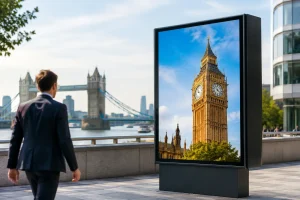
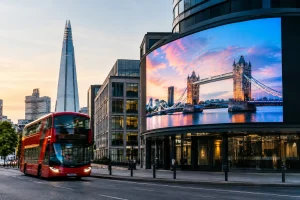
Roadside digital billboards are often the headline investment because they turn passing traffic into an audience. For parks in prominent roadside locations, that visibility can be valuable both for the operator and for tenants wanting to promote time-sensitive offers. A static sign cannot compete with the flexibility of scheduled, changeable content across the trading week.
At entrance points, digital displays can reduce confusion and create a more organised arrival experience. Simple messages about store openings, parking guidance, customer notices or promotional campaigns can make a site feel better managed. That matters more than many buyers initially expect. Clear communication shapes the customer impression before they have even reached a unit.
Deeper into the park, digital signage supports dwell time and spending. Screens near pedestrian routes or shared spaces can highlight dining offers, cross-promote stores and keep messages current without the delay and waste of printed materials. If the park hosts events, seasonal activations or brand partnerships, digital screens make those campaigns easier to update and more consistent across the site.
Getting the specification right first time
This is usually the point where a project succeeds or becomes unnecessarily expensive. Buyers can be tempted to compare screens on headline price alone, but retail park environments are demanding. A lower upfront cost can quickly lose its appeal if brightness is inadequate, the enclosure is poorly suited to outdoor conditions, or maintenance becomes a recurring issue.
Brightness is one of the first practical considerations. Outdoor screens in retail parks must remain legible in variable British weather, including bright summer daylight and low winter sun. The right level depends on the screen position, orientation and surrounding environment. Too little brightness affects visibility. Too much, without proper control, can create issues for nearby occupiers or roads.
Pixel pitch is another area where context matters. A screen viewed mainly by passing traffic at distance has different requirements from a display read by pedestrians at close range. Choosing the right pitch is not about buying the finest resolution available. It is about matching image quality to actual viewing distance and budget.
Then there is the physical structure itself. Wind loading, access for maintenance, foundations, power supply, data connectivity and compliance all need careful attention. On a live commercial site, installation has to be planned around traffic flow, tenant operations and public safety. This is why experienced site survey and project management are so important. A good supplier does not simply provide a screen. They help make sure the whole system works in the real environment.
Content flexibility is where the commercial value grows
The main operational advantage of digital signage for retail parks is flexibility. Messages can be updated quickly, scheduled by time of day and adapted for different audiences. That gives site managers and marketing teams much greater control than print ever could.
A morning message might promote breakfast offers or opening times. Later in the day, the same screen can advertise fashion, homeware or leisure promotions. In the run-up to Christmas, Black Friday or bank holiday weekends, campaign changes can be made without reprinting and replacing site-wide signage.
For multi-tenant locations, this flexibility is commercially useful because it allows operators to allocate screen time fairly and efficiently. Some parks use digital signage to support tenant value as part of the wider leasing proposition. Others build a more direct media model, offering advertising slots to occupiers or third-party brands. The right approach depends on footfall, traffic counts and how the site is positioned in the local market.
That said, flexibility only helps if content is managed sensibly. Too many messages, poor design or badly timed scheduling can weaken impact. Clear creative, disciplined playlists and realistic dwell-time assumptions usually outperform overcomplicated content plans.
Reliability matters more than novelty
In a procurement meeting, it is easy for the conversation to focus on visual impact. In day-to-day operation, reliability is what protects the investment. A screen that looks impressive on launch day but suffers avoidable downtime will quickly become a frustration for both operators and tenants.
Retail parks need systems built for continuous commercial use. That includes dependable LED components, suitable weather protection, sensible thermal management and support arrangements that do not leave the client chasing answers when a fault occurs. Software and connectivity choices also need to be practical. Some sites require straightforward local content control. Others need remote management across multiple displays or integration with wider advertising schedules.
There is no single right setup for every scheme. A smaller regional park may need a simple, durable solution that local teams can manage with minimal training. A larger destination site may require a more advanced network with multiple screen formats and central scheduling. The point is to specify for the actual operating model, not for a feature list.
A consultative approach reduces project risk
Large-format digital signage is not a casual purchase. Buyers are rightly cautious because the investment affects planning, infrastructure, health and safety, tenant expectations and public presentation. The supplier’s role should be to reduce that complexity, not add to it.
That means asking the right questions early. What is the commercial purpose of the screen? Who will manage content? What are the likely viewing distances? How exposed is the location? What access will be available for service and maintenance? Are there planning sensitivities or nearby roads to consider? These details shape the right solution and help avoid expensive changes later.
This is also where British manufacturing and technical support can be a genuine advantage. For many operators, accountability matters just as much as product specification. They want to know who designed the system, who installed it, and who will still be available if support is needed in the future. That long-term relationship is often what separates a good project from a troublesome one.
With more than 45 years of industry experience, LEDsynergy Billboards understands that getting it right first time is not a slogan. It is what clients expect when a digital display is being installed in a busy public-facing environment.
Digital signage for retail parks should fit the site, not the other way round
The most effective schemes are not chosen from a shelf. They are designed around the site’s layout, commercial priorities and practical constraints. One retail park may benefit most from a prominent roadside billboard that captures passing traffic. Another may see stronger value from entrance signage, wayfinding screens and tenant-focused promotional displays across the park.
There are trade-offs in every project. A larger screen may increase visibility but require more structural work. A finer pixel pitch may improve close-up image quality but add cost where it offers little real benefit. A more complex content network may suit a destination site but be unnecessary for a smaller park with simpler needs.
That is why the best outcomes usually come from careful planning, realistic expectations and a supplier who is prepared to advise rather than simply sell.
Retail parks are under constant pressure to attract visitors, support tenants and make better use of every square metre. Digital signage can play a valuable role in all three, provided it is designed with purpose and installed with care. When the screen, structure, software and support are all aligned with the site, the result is not just a brighter display. It is a stronger, more commercially useful asset.

I would recommend LED Synergy to anyone considering purchasing an LED sign. We have had so many compliments since it was installed and it has been a valuable asset.
Tom Hughes
OSI Food Solutions