
Screen Brightness for Daylight Visibility
A screen can look superb in a showroom and still disappoint on site at 1pm in full sun. That is why screen brightness for daylight visibility should be one of the first discussions in any digital signage project, not a specification buried near the end. For buyers investing in outdoor advertising screens, transport displays or public-facing venue signage, brightness has a direct effect on legibility, audience impact and commercial return.
Too often, brightness is treated as a race to the biggest number. In practice, the right answer depends on where the screen sits, what is around it, who needs to read it and how the content is used. A display facing south on an exposed roadside has a very different job from one mounted beneath a shopping centre canopy.
Why screen brightness for daylight visibility matters
Daylight visibility is not simply about making a screen look vivid. It is about ensuring the message remains readable and effective under real-world conditions. If text washes out, brand colours lose contrast or imagery becomes hard to interpret, the display is not doing its job, regardless of how impressive it looks in lower light.
For commercial operators, that has obvious consequences. Advertisers want confidence that campaigns will be seen clearly throughout trading hours. Property teams need displays that support the quality of the site rather than appearing dim or underpowered. Facilities managers want equipment that performs reliably without constant adjustment or complaints.
This is where experience matters. The right brightness level must be considered alongside viewing distance, ambient light, screen orientation, surrounding materials and the operational demands of the site. Getting it right first time avoids costly compromises later.
Brightness figures are useful, but context matters more
Brightness is commonly measured in nits, and higher nit ratings generally mean a screen can produce a brighter image. That sounds straightforward, but the number on its own never tells the full story.
A screen installed in partial shade may not need the same output as one placed in direct sunlight all day. Equally, a very bright display in the wrong location can create issues of its own, including discomfort for nearby viewers, unnecessary energy use and a picture that appears harsh rather than clear.
The better approach is to assess the environment first and then specify brightness accordingly. On many outdoor projects, screen orientation is just as important as nominal brightness. If the display faces the sun for long periods, the required performance level changes immediately. If nearby glazing, pale paving or reflective building finishes increase glare, that also affects the specification.
The balance between brightness and readability
Brightness alone does not guarantee readability. Contrast, pixel pitch, content design and the quality of the LED components all play a part. A poorly designed campaign with low contrast colours may remain difficult to read even on a bright screen. Likewise, a display with suitable brightness but the wrong pixel pitch for the viewing distance may fail to communicate cleanly.
That is why a consultative approach is so important. A proper assessment looks at the whole display solution rather than one headline figure.
What affects daylight performance on an LED screen?
Ambient light is the obvious factor, but it is not the only one. In the UK, daylight conditions vary widely across seasons, times of day and weather patterns. Brightness needs to cope not just with clear summer sun, but also with shifting cloud, low winter light and reflective glare after rain.
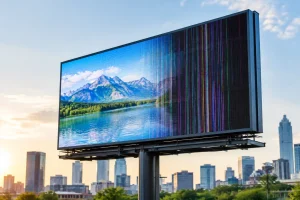
Screen location has a major influence. A billboard on an open roadside, a digital sign on a retail park entrance and a display inside a glazed atrium all face different lighting conditions. Even two screens on the same site may need different solutions if one is shaded and the other fully exposed.
Surface reflections matter as well. The display face, louvre design and overall cabinet build can improve perceived visibility by managing how ambient light interacts with the screen. This is one reason why like-for-like comparisons between displays can be misleading. Two products with similar brightness ratings may perform differently on site because of differences in component quality and engineering detail.
Content has more impact than many buyers expect
A daylight-visible screen still needs daylight-suitable content. Thin typefaces, pale backgrounds and low-contrast creative often struggle outdoors. Motion can help attract attention, but if the message is too busy, viewers may miss the key point entirely.
For roadside and high-footfall environments, clarity usually wins. Strong contrast, concise messaging and imagery designed for the screen’s actual viewing conditions deliver better results than artwork adapted from print or desktop formats.
How much brightness do you actually need?
There is no single figure that suits every project, and any supplier who treats it that way is oversimplifying the job. The sensible question is not, “What is the brightest screen available?” but, “What level of brightness is appropriate for this location and use case?”
For fully outdoor digital billboards and displays in direct daylight, higher brightness levels are often essential. For semi-outdoor locations, covered walkways or screens set back from direct sun, lower levels may be perfectly suitable and more cost-effective. Internal displays near large glazed façades can also need more output than buyers initially expect, even though they are technically indoors.
A proper site survey should review sunlight exposure, viewing angles, audience dwell time and local surroundings before the final specification is agreed. This is one of the clearest ways to reduce procurement risk. It avoids both under-specifying, where the screen lacks impact, and over-specifying, where capital and running costs rise without practical benefit.
Screen brightness for daylight visibility and running costs
Brightness has a direct relationship with power consumption, so there is a financial dimension as well as a visual one. A brighter screen generally draws more power, especially if it is operating at high output for long periods.
That said, the conversation should not stop at energy use alone. A screen that is too dim for its environment may save some electricity, but it can also weaken campaign performance, reduce perceived quality and create a poor impression of the site. On the other hand, overspecifying brightness when it is not needed can increase costs unnecessarily.
The best modern systems manage this with automatic brightness control. Sensors allow the display to adjust output according to ambient conditions, so the screen remains visible in strong daylight without running at maximum brightness all the time. This improves efficiency, supports component longevity and creates a more comfortable viewing experience in changing light.
Reliability is part of the brightness discussion
A screen’s brightness capability is only valuable if it remains consistent over time. In demanding public environments, reliability is not a luxury. It is central to the investment.
Buyers should look beyond headline specifications and ask practical questions about component quality, thermal management, maintenance access and aftercare. A well-built display backed by proper support is far more likely to deliver stable long-term performance than a lower-cost alternative chosen on paper figures alone.
Common mistakes when specifying outdoor screen brightness
One of the most common mistakes is buying from a generic data sheet rather than from the site itself. Another is focusing too narrowly on brightness while ignoring contrast, content suitability and viewing distance. We also see projects where a screen is chosen before the installation position is fully resolved, which can create avoidable visibility issues later.
There is also a tendency to assume every outdoor application needs the maximum available brightness. Sometimes that is correct. Sometimes it simply adds cost and complexity without improving communication. The right solution is the one that matches the operational reality of the screen.
For organisations managing estates, transport hubs, leisure venues or retail destinations, that practical fit matters. The display must work day after day, through changing seasons and variable conditions, without becoming a maintenance burden or a source of disappointment for advertisers and end users.
Choosing a supplier who understands daylight visibility
When brightness is discussed properly, it is rarely a standalone technical point. It sits within a bigger conversation about site conditions, commercial aims, installation requirements and long-term support. That is why specialist input is valuable from the start.
An experienced manufacturer and installer will not simply quote a brightness figure and move on. They will ask how the screen will be used, when it needs to perform best, what the audience needs to see and what physical constraints apply on site. They will also be realistic about trade-offs, whether that means balancing brightness with energy use, or advising when a different screen position would improve results.
For many buyers, that level of guidance is what turns a complex procurement into a manageable project. It is also what helps ensure the finished display performs as expected in daylight, not just in a proposal document.
If you are planning a new billboard, venue display or public-facing digital screen, treat brightness as part of the wider engineering decision, not a marketing headline. A screen that stays clear, controlled and effective in real daylight will always do more for your site than one that simply claims the biggest number.

I would recommend LED Synergy to anyone considering purchasing an LED sign. We have had so many compliments since it was installed and it has been a valuable asset.
Tom Hughes
OSI Food Solutions