
Front Service LED vs Rear Access: Which Fits?
A digital billboard may look like a single, uninterrupted display from the road, but its service arrangement can determine whether maintenance is straightforward or an operational headache. The front service LED vs rear access decision affects the space behind the screen, the steelwork design, engineer safety, installation cost and, ultimately, how quickly a fault can be addressed.
For property operators, venue managers and advertising network owners, this is not simply a technical specification to tick off. It is a practical site-planning decision that should be made before manufacture and installation, not after the screen is in place.
What front service and rear access mean
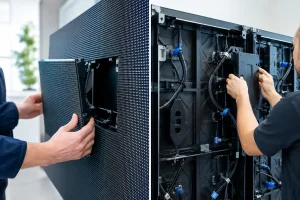
A front service LED display is designed so that modules, power supplies and receiving cards can be accessed from the face of the screen. An engineer removes individual LED modules or opens purpose-designed front access points using the correct tools, carrying out maintenance without needing to stand behind the display.
Rear access LED displays are serviced from the back. The installation therefore needs a safe, usable maintenance area behind the screen, often through a rear walkway, cabinet doors, a service corridor or access from within a building structure.
Both arrangements can provide excellent image quality and dependable operation. The better choice depends on the available space, the screen location, the operating environment and the level of access that can realistically be maintained throughout the display’s working life.
Front service LED vs rear access for tight sites
Front service LED is often the practical answer where there is little or no room behind the display. This can include wall-mounted screens, displays built into façades, shopping centre installations, roadside structures with restricted rear clearance and indoor screens positioned against a finished wall.
Its obvious advantage is that the screen can sit close to the supporting surface. There is no need to reserve a rear maintenance corridor solely for engineers, which may reduce the overall depth of the installation and make a previously difficult location viable.
This matters particularly on commercial sites where every square metre has a value. A landlord may want to preserve a walkway, retail unit area, loading space or back-of-house route rather than lose it to a service void. In these circumstances, front access can make a digital display possible without compromising the building’s day-to-day use.
There is also a clear operational benefit. When a module needs replacing, a qualified engineer can generally work from the front of the display rather than arranging access through private areas, locked compounds or internal plant rooms. That can shorten the route from reported fault to completed repair.
However, front service is not automatically the right answer for every site. Engineers need safe access to the face of the screen. On a large roadside billboard, this may mean a suitable platform, gantry, mobile elevated work platform or other planned working-at-height provision. The space behind the screen may be saved, but safe front access must still be considered properly.
When rear access is the stronger option
Rear access remains a sound and often cost-effective choice where a purpose-built service area is readily available. A freestanding digital billboard with a secure rear walkway, for example, can give engineers direct access to cabinets and electronics without disturbing the display face.
For some large-format outdoor installations, rear access can also make routine inspection more comfortable and efficient. Power distribution, data equipment and cabinet components are reached from a protected area, while the front remains intact and focused on the audience-facing finish.
The key is to be honest about the access arrangement. A narrow gap that appears adequate on a drawing may not be suitable once cabling, structural members, door swing clearances and engineer movement are taken into account. Rear servicing only works well when there is enough safe room to work, adequate lighting, sensible entry arrangements and a route that remains available after the wider site develops.
A rear access screen can be particularly appropriate where the display forms part of a new-build scheme. If the service corridor is designed into the structure from the start, it can offer a tidy, secure and practical long-term solution. It may also allow greater flexibility in cabinet configuration for certain projects.
Maintenance, uptime and fault response
The service method does not determine whether an LED screen will be reliable. Quality of manufacture, component selection, thermal management, installation standards, environmental protection and ongoing support all play a larger part in long-term performance.
What access does influence is the ease of planned maintenance and repair. A display with excellent components but poor physical access can take longer to service than a well-designed system where engineers can reach the relevant part safely and efficiently.
Front service designs are helpful where access behind the screen would be disruptive or impossible. Rear access designs can be equally efficient where a dedicated service route is available. The most dependable solution is the one that matches the real conditions on site, rather than the one that merely looks simpler in a quotation.
For any commercial display, the maintenance strategy should account for more than module replacement. Engineers may need to inspect ventilation, check fixings, test power supplies, review data connections and assess the condition of weather seals. A properly specified system makes these routine tasks manageable, helping to protect screen availability and advertising revenue.
Cost is more than the screen price
It is tempting to compare front service LED and rear access only by the initial equipment cost. That comparison can be misleading. Front-service cabinets and mechanisms may carry a different manufacturing cost, while rear access may require additional steelwork, a service platform, a corridor or alterations to the building.
The relevant question is the whole-life cost of the installation. Consider the screen, structure, access provision, installation programme, future maintenance visits and the commercial impact of downtime. A lower initial figure can become less attractive if it creates difficult servicing conditions for the next decade.
For a retail environment, the cost of closing off part of a public area or coordinating out-of-hours access may outweigh the value of a simpler cabinet arrangement. For a purpose-built roadside site, a rear service platform may be the most sensible and economical approach. There is no universal winner because the physical constraints are different.
Safety should shape the specification early
Service access should never be treated as an afterthought. Whether maintenance takes place from the front or rear, the arrangement needs to support safe working procedures, suitable access equipment and clear responsibility for site access.
For outdoor displays, weather exposure, traffic proximity and working height deserve particular attention. For indoor installations, the main considerations may include public circulation, ceiling height, fire routes, tenant operations and the ability to isolate equipment safely.
A site survey is the point at which these factors should be identified. It allows the display size, cabinet design, mounting method and service approach to be developed together. This avoids the costly situation where a screen has been selected before anyone has confirmed how it will be maintained.
Questions to settle before choosing
The most useful discussion is not simply, “Do we want front or rear service?” It is, “How will an engineer safely reach every serviceable component once the screen is operational?”
Start with the available space. Is there a permanent and secure route behind the display, or will the screen sit directly against a wall or façade? Then consider front access. Can a technician reach the face safely without causing unacceptable disruption to traffic, shoppers, tenants or visitors?
Next, look at the operating model. A display that carries paid advertising or critical passenger information may need particularly fast fault response. A venue screen used only at occasional events may have different priorities. Finally, consider the future. Will building works, new tenants, landscaping or security changes make today’s access route harder to use in two or five years’ time?
A bespoke approach avoids false compromises
Standard products can encourage buyers to adapt their site around the screen. For a high-value LED installation, the better approach is to specify the screen around the site and its operational requirements.
That may mean a front-service display with carefully planned face access, a rear-service arrangement integrated into new steelwork, or a combination of approaches across a larger installation. Cabinet dimensions, pixel pitch, brightness, environmental rating, control systems and supporting structure should all be considered alongside service access.
LEDsynergy Billboards approaches projects in this way because the details matter long after commissioning day. A display should not only look impressive at launch. It should remain practical to maintain, safe to service and dependable for the people who rely on it.
The right choice becomes clearer when the proposed location is assessed properly. A well-planned access strategy gives your screen the best chance of delivering reliable performance without creating avoidable cost, disruption or risk later on.


I would recommend LED Synergy to anyone considering purchasing an LED sign. We have had so many compliments since it was installed and it has been a valuable asset.
Tom Hughes
OSI Food Solutions