
Choosing a Commercial LED Display Manufacturer
A digital screen can look impressive in a proposal and still become a headache once it is on site. That is usually the point where the difference between a reseller and a proper commercial LED display manufacturer becomes very clear. If your project needs to perform every day, in all weather, under real operational pressure, the quality of the manufacturer matters just as much as the screen itself.
For buyers in retail, property, leisure and transport, this is rarely a simple purchase. You are not just buying pixels. You are committing to a system that affects visibility, revenue, maintenance demands, site logistics and brand presentation. Getting it right first time saves more than money. It avoids disruption, protects your reputation and gives your team confidence in the investment.
What a commercial LED display manufacturer should actually provide
At face value, many suppliers can offer an LED screen. Fewer can take responsibility for the full job. A genuine commercial LED display manufacturer should be able to advise on specification, assess the site properly, build to the application, manage installation and support the screen long after commissioning.
That matters because LED display projects are full of variables. Viewing distance affects pixel pitch. Sunlight levels affect brightness requirements. Structural conditions affect cabinet design, weight and mounting method. Connectivity, content management and servicing access all influence what will work well in practice. If those decisions are made in isolation, costs can rise later through redesigns, premature failures or disappointing screen performance.
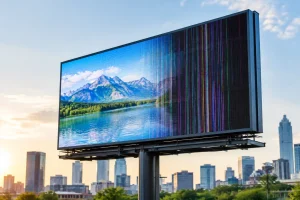
The strongest manufacturers do not start by pushing a standard product. They start by understanding the site, the audience and the commercial purpose of the display. In some settings, that leads to a large-format roadside billboard. In others, it may mean a screen integrated into a retail frontage, a transport hub information display or a bespoke 3D installation designed to attract attention in a competitive location.
Why bespoke manufacturing often makes better commercial sense
There is a common assumption that bespoke means expensive and standard means economical. In LED display projects, it is often more complicated than that. A supposedly off-the-shelf screen can become costly if it does not fit the structure, needs adaptation on site or fails to meet environmental demands.
Bespoke manufacturing allows a display to be built around the real conditions of the installation. That can include cabinet dimensions, structural loading, service access, brightness levels, weather protection and integration with existing buildings or support steelwork. The aim is not to over-engineer the system. It is to specify what is appropriate and cost-effective for the intended use.
This is especially relevant for organisations managing public-facing environments. Shopping centres, business parks, leisure venues and roadside locations all have different demands. The right display for a sheltered indoor concourse may be completely wrong for an exposed roadside advertising site. A manufacturer with practical experience will explain those trade-offs clearly rather than leaving the client to discover them after installation.
Reliability is not a brochure claim
When buyers compare LED screens, headline figures can be misleading. Brightness ratings, refresh rates and cabinet sizes are easy to list. Reliability is harder to judge, yet it is often the factor that matters most over the life of the display.
A dependable commercial screen should be designed for sustained operation, not occasional use. It should cope with temperature changes, moisture, vibration, electrical demands and long daily running hours. It should also be maintainable. Even a well-built screen will need servicing eventually, and the design should make that process straightforward rather than disruptive and expensive.
This is where manufacturer accountability matters. If the same business is involved in design, build, installation and support, there is far less room for ambiguity when something needs attention. You know who to call, and they know the system because they had a hand in delivering it.
For procurement teams and facilities managers, that accountability reduces risk. It also tends to produce better decisions at the start of the project, because the manufacturer has to stand behind the end result rather than simply fulfil an order.
The site survey is where good projects are won
A proper site survey often tells you more about a manufacturer than any sales presentation. An experienced team will assess not only where the screen could go, but whether it should go there in the first place.
They will look at sightlines, ambient light, structural constraints, power supply, data connectivity, traffic or footfall patterns, access for installation and future maintenance requirements. They will also consider planning implications, operational disruption and any practical limitations that could affect programme or cost.
That level of detail can feel cautious, but it is how reliable projects are delivered. A digital billboard or large-format display is a visible asset. If it underperforms, suffers repeat faults or proves difficult to maintain, those issues are not hidden behind the scenes. They are seen by your customers, tenants, visitors and stakeholders.
A careful survey also helps with commercial planning. There is no value in specifying a high-output system if the location does not justify it. Equally, a lower-cost option is not a saving if it leaves the screen unreadable in daylight or unsuitable for the content being shown.
Installation experience matters as much as manufacturing
Even a well-made screen can be compromised by poor installation. Alignment, weatherproofing, cable management, structural fixing, commissioning and calibration all affect long-term performance. This is why experienced buyers tend to favour suppliers who can manage the installation properly rather than pass responsibility through several subcontracted layers.
In real-world environments, installations are rarely perfectly straightforward. Access windows can be tight. Public safety controls may need to be coordinated. Existing structures do not always match drawings. Power and communications routes can change at short notice. A hands-on manufacturer with installation expertise is usually better placed to respond without losing control of the project.
This is particularly important for larger roadside billboards, transport settings and complex urban sites, where timing, compliance and safety procedures must be handled professionally. Confidence comes from working with a team that has seen these conditions before and knows how to deliver without unnecessary drama.
Support after commissioning is part of the product
Too many buyers are sold a screen as if the project ends when it switches on. In practice, the support model is part of the purchase decision. Software questions, connectivity issues, content changes, diagnostics and component servicing all sit within the working life of the display.
A strong manufacturer will be clear about warranty terms, response expectations and the practicalities of ongoing support. They should also be able to advise on how the screen will be managed day to day, especially if multiple stakeholders are involved. For some sites, that may mean simple advertising playback. For others, it may involve scheduling, remote monitoring or integration with wider signage systems.
What matters is not whether every project uses the same support arrangement. It is whether the support reflects the operational reality of the site. A leisure venue with long opening hours may need something different from a property group managing multiple locations. A transport environment may place a premium on uptime and rapid fault response. It depends on the application, which is exactly why the support model should never be treated as an afterthought.
How to assess a commercial LED display manufacturer
When you are comparing suppliers, the most useful questions are usually the practical ones. Ask who is responsible for design, manufacturing, installation and aftercare. Ask how the specification is developed and whether a site survey is included. Ask what is bespoke and what is standard. Ask how maintenance is handled, what warranty support looks like and what happens if a problem appears six months after handover.
You should also look for evidence of repeat business and long-term customer relationships. In this sector, that often says more than a polished pitch. Organisations tend to return to manufacturers who communicate well, solve problems quickly and deliver what was promised.
There is also value in choosing a partner that understands the commercial context of the display. A screen is not only an engineering project. It may be an advertising asset, a tenant communication tool, a revenue generator or a way to improve the visitor experience. The right manufacturer will keep that wider purpose in view instead of treating the job as a box-moving exercise.
For many UK buyers, there is an added advantage in working with a British manufacturer. Communication is simpler, site support is easier to coordinate and there is greater confidence in accountability throughout the project. For specialist providers such as LEDsynergy Billboards, that combination of local manufacturing, technical experience and end-to-end service is often what gives clients the reassurance to proceed.
A commercial LED display should earn its place on your site for years, not just look good on day one. The best manufacturer is the one who takes that responsibility seriously, asks the right questions early and stays involved long after the screen goes live.

I would recommend LED Synergy to anyone considering purchasing an LED sign. We have had so many compliments since it was installed and it has been a valuable asset.
Tom Hughes
OSI Food Solutions