
Best Leisure Venue Displays for Busy Sites
A packed foyer before a show, a queue at the bar during half-time, families arriving for bowling or a fitness class – these are valuable moments for communication. The best leisure venue displays do more than brighten a wall. They help visitors find their way, promote the next booking, support sponsors and give venue teams the ability to change messages without replacing printed posters.
For operators, the real decision is not simply screen size or resolution. It is whether the display will remain clear, dependable and easy to manage in a busy public environment. A well-specified LED display can become part of the venue’s commercial and operational infrastructure. A poorly specified one can create glare, fail to hold attention or become difficult to maintain at the point it is needed most.
What makes a leisure display worth the investment?
Leisure venues have a different set of demands from a standard retail unit or office reception. Visitors are often moving quickly, arriving in groups and looking for immediate direction. Light levels can change dramatically between a glazed entrance, a dimly lit corridor and an outdoor concourse. Content also has to work for more than one audience: customers, members, event organisers, staff and advertisers.
The strongest display projects begin with the job each screen needs to do. A large outdoor LED screen may be intended to attract passing traffic and advertise forthcoming events. An indoor display at a cinema, trampoline park or sports venue may need to reduce pressure on staff by showing schedules, safety notices and pricing. A screen near food and drink counters can increase spend by promoting time-sensitive offers while customers are already waiting.
This is why an apparently cheaper, off-the-shelf display is not always the most cost-effective choice. If brightness, viewing angle, housing, control system or mounting method is wrong for the location, the screen may need compromise from day one. Bespoke planning costs time at the outset, but it reduces avoidable changes later.
Start with the visitor journey, not the screen
Before selecting a product, walk the venue as a visitor would. Consider what people need to know at the entrance, ticket point, changing rooms, concourse, bar area and exit. Look at where people naturally stop, where queues form and which sightlines are blocked by doors, furniture or seasonal installations.
A display positioned at the right decision point is often more valuable than a larger screen placed where nobody pauses to look. For example, a leisure centre may benefit from a clear programme board at reception and a separate, brighter screen at the roadside. A stadium hospitality area may need refined event messaging indoors, while the external approach needs high-impact sponsor and fixture information.
It also helps to decide whether content is primarily viewed close up or from a distance. This informs pixel pitch, which is the spacing between individual LED pixels. A fine pixel pitch delivers a sharper image at close range, but may be unnecessary and more expensive for a screen viewed from across a car park. The right specification should suit the actual viewing distance rather than follow a generic rule.
Consider daylight, weather and operating hours
Outdoor displays need sufficient brightness to remain readable in direct sunlight, but brightness alone is not the whole answer. An effective system should adjust sensibly to ambient light so it remains comfortable to view after dark and meets the needs of the surrounding setting. The cabinet design, drainage, ventilation and weather protection must be appropriate for the UK climate, including driving rain and fluctuating temperatures.
Indoors, reflections are frequently the issue. Glazed foyers, polished floors and overhead lighting can all affect readability. A site survey identifies these practical details before a screen has been manufactured or a mounting position has been fixed.
Long operating hours should shape the specification too. A display running from early morning gym sessions to late-night entertainment needs components and cooling arrangements designed for sustained use. Reliability is especially important where the screen carries live schedules, safety messages or paid advertising commitments.
Choose the right display type for the location
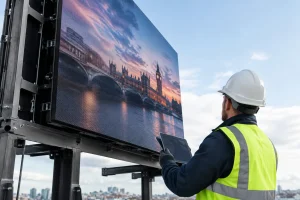
There is no single format that suits every leisure setting. Large-format outdoor LED billboards are effective where visibility from roads, pedestrian routes or venue approaches is the priority. Their scale gives operators room to promote the venue’s own programme while creating an advertising opportunity for local businesses and partners.
Indoor LED walls work well in entrances, feature spaces, arenas and high-footfall circulation areas. They can deliver an immersive visual presence for events, brand campaigns and live information. Where the display forms part of a premium hospitality or entertainment offer, the quality of the image, cabinet finish and integration with the interior all matter.
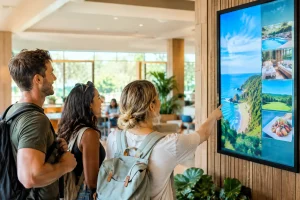
Digital poster displays and smaller information screens have a place too. They are useful where messages need to be distributed across multiple points, such as reception desks, café areas and corridors. The trade-off is impact: a network of smaller screens can improve wayfinding and day-to-day communications, while one large LED screen is better suited to creating a focal point and selling high-value advertising space.
For sites with an unusual façade, curved wall or a requirement to stand apart, a custom-built solution may be the sensible option. Three-dimensional display concepts can attract attention in the right location, but they need content designed for the format and a clear commercial purpose. The technology should support the venue’s objective, not become an expensive novelty.
Make content management part of the specification
A display is only as useful as the content team’s ability to update it. Venue managers should establish who will control the screen, how often messages need changing and whether content will come from one central team or several approved users. These questions affect the choice of software, connectivity and training.
For a multi-use venue, planned scheduling is particularly valuable. A display may show family activities in the morning, promote food and drink in the afternoon, carry event information before doors open and switch to sponsor messages at peak evening periods. The system should make this straightforward without requiring specialist technical knowledge for routine updates.
Content must be designed for people in motion. Use clear hierarchy, readable type and short messages. A bright animation may catch the eye, but it should not make essential information harder to absorb. Where advertisers are involved, agree artwork specifications and approval processes early. This protects the screen’s visual standard and avoids last-minute content problems.
Build the commercial case around more than advertising
Advertising income is a compelling reason to invest in a digital display, particularly for venues with dependable footfall and a strong local audience. Local attractions, hospitality businesses, colleges, property firms and event partners may all value a well-positioned screen. Yet revenue forecasts should be realistic. The value of advertising inventory depends on visibility, dwell time, audience profile, sales resource and the number of competing opportunities nearby.
The broader return is often easier to prove. Digital displays reduce recurring print costs, make promotions more timely and help staff communicate changes quickly. They can direct visitors towards underused facilities, increase participation in classes or events, and strengthen a venue’s perceived quality before a customer reaches the reception desk.
For procurement teams, look beyond the purchase price. Include site preparation, structural requirements, electrical works, data connectivity, installation access, content management, warranty and planned support. A supplier that handles these elements in a coordinated way gives the project a clearer route from initial survey to commissioning.
Why installation and support matter as much as the screen
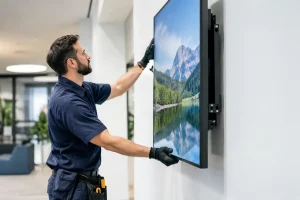
A leisure venue cannot usually close its busiest areas for long. Installation needs to account for public access, operating hours, health and safety, lifting equipment, cable routes and the finish of the surrounding space. The right installer will plan around these constraints rather than treat them as an afterthought.
The same principle applies after commissioning. Ask what happens if a module needs replacing, connectivity drops or a screen requires remote diagnostics. Clear support arrangements and readily available technical expertise reduce disruption when the display is part of daily operations.
With more than 45 years of display experience, LEDsynergy Billboards approaches these projects as a complete system, from consultation and site survey through to British-built manufacture, installation and ongoing support. That joined-up responsibility is valuable when a venue needs a solution tailored to its site rather than a standard screen delivered to the door.
Questions to settle before placing an order
A sound brief should answer a few practical questions: what is the screen expected to achieve; where will audiences view it from; what content will run on it; who will manage that content; and what level of commercial return is realistic? It should also confirm planning considerations, electrical capacity, structural suitability and whether network access is available where the display is proposed.
Do not be afraid to ask a prospective supplier to explain the reasoning behind the recommended pixel pitch, brightness level and display dimensions. The best answer will be specific to your site and your audience, not simply the most expensive specification available.
The right display should earn its place every day: guiding a first-time visitor, giving a sponsor proper visibility, helping staff share timely information and making the venue feel as professional at 8pm on a busy Saturday as it does during a quiet weekday morning.
I would recommend LED Synergy to anyone considering purchasing an LED sign. We have had so many compliments since it was installed and it has been a valuable asset.
Tom Hughes
OSI Food Solutions