
Top Digital Displays for Transport Interchanges
Rush hour gives you a very honest test of signage. If a screen cannot be read quickly, cope with harsh daylight, and keep working through long operating hours, it has no place in a busy station, bus hub or airport forecourt. That is why choosing the top digital displays for transport interchanges is less about novelty and more about visibility, reliability and getting the specification right for the site.
For operators, landlords and commercial teams, the challenge is rarely just buying a screen. It is deciding which display format suits passenger flow, what level of brightness is genuinely needed, where advertising revenue fits alongside public information, and how to install a system that will perform consistently in a demanding environment. The right answer depends on the interchange itself, because a covered concourse, an outdoor bus station and a rail platform entrance all ask different things of the technology.
What makes a display right for a transport interchange?
Transport environments are unforgiving. Footfall is high, dwell time varies, ambient light changes throughout the day, and viewers are often moving rather than standing still. In practice, that means display selection should start with legibility and durability before anything else.
A good interchange screen must be bright enough for the location, but brightness on its own does not guarantee a good result. Pixel pitch, viewing distance, contrast and content design all affect whether a message is actually readable. A large-format LED screen above a main entrance can carry bold campaign creative brilliantly, yet the same format may be the wrong choice for timetable-style messaging viewed at close range.
The operating model matters too. Some sites need displays primarily for wayfinding and operational updates. Others are built around third-party advertising income, with information content layered around commercial inventory. Most interchanges sit somewhere in the middle, so the strongest schemes are planned around mixed use rather than a single purpose.
Top digital displays for transport interchanges by application
When clients ask about the top digital displays for transport interchanges, the best option usually falls into one of four categories. Each has a clear role, and each comes with trade-offs.
Large outdoor LED billboards
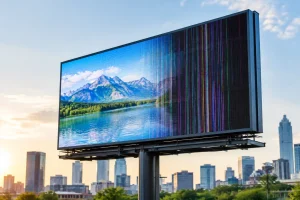
For external approaches, forecourts and roadside visibility, large outdoor LED billboards remain one of the strongest performers. They are ideal where the objective is to capture drivers, pedestrians and passengers before they even enter the interchange. In the right location, they create immediate impact and offer excellent advertising value because they command attention at scale.
Their strength is reach, not detail. These screens work best with clear, bold creative and short messaging. If the content is text-heavy or expected to carry complex travel information, another format will usually be more suitable. Weather resistance, structural design and access for maintenance are also critical here, particularly in exposed sites.
Indoor fine-pitch LED screens
Inside concourses and ticket halls, fine-pitch LED can be a very effective choice where operators want a premium, high-resolution display. These screens suit welcome walls, central information zones and high-value advertising positions where people are closer to the display and image quality needs to hold up at shorter viewing distances.
The benefit is presentation quality. The trade-off is cost. Fine-pitch installations are typically a larger capital investment than standard large-format solutions, so they need to be justified by either the commercial return, the strategic importance of the space, or the visual standard expected in the venue.
LCD digital signage networks
For corridor walls, retail units within interchanges, gate areas and enclosed waiting zones, professional LCD displays still have a very practical role. They are often the right choice for menu-style content, detailed messaging, departure information overlays and multi-screen networks spread across a building.
They are usually more cost-effective for close-up viewing and structured content. That said, they are not a replacement for LED in every setting. Bright sunlight, very large screen requirements and long-distance visibility can expose their limits. In busy transport estates, LCD works best where the environment is controlled and the content needs more detail than a large LED billboard would comfortably carry.
Double-sided and freestanding totems
Where passengers move through defined routes, freestanding digital totems and double-sided displays can be highly effective. They help make use of circulation spaces without relying on wall mounting, and they are particularly useful for entrances, pedestrian links and interchange points between bus, tram and rail services.
Their value lies in orientation and flexibility. They can support wayfinding, service messaging and advertising in one footprint. The key consideration is placement. If a totem interrupts flow, creates bottlenecks or sits outside natural sightlines, its value drops quickly. In transport sites, physical layout is every bit as important as screen specification.
The buying factors that matter most
A display can look impressive on a spec sheet and still be wrong for the job. The better approach is to judge each solution against the site conditions and the commercial objective.
Brightness is a clear example. Outdoor and semi-outdoor locations often need high-brightness LED to stay visible in direct sunlight, while covered indoor areas may need a more balanced approach to avoid glare and viewer discomfort. More brightness is not always better. It has to suit the environment and local operating conditions.
Screen size is another area where buyers can go wrong. Larger is not automatically more effective. A screen should be sized around viewing distance, surrounding architecture and the role it plays in the customer journey. A very large display in the wrong position can be less useful than a smaller screen placed exactly where decisions are made.
Content management should also be considered early. Transport operators and property teams need systems that can be updated reliably, scheduled sensibly and, where required, integrated with operational messaging. If advertising, public information and emergency messaging all need to coexist, the content strategy has to be built into the project from the outset rather than bolted on later.
Then there is maintenance. In public transport environments, downtime is visible and costly. Access routes, service response, spare parts planning and long-term support all deserve proper attention at procurement stage. Buyers are not just purchasing a display. They are investing in a working system that needs to perform day after day.
Why bespoke solutions often outperform off-the-shelf packages
Transport interchanges are rarely neat, standardised spaces. Ceiling heights vary, structural fixing options are limited, ambient light can shift across a single site, and audience behaviour changes by zone. That is one reason bespoke display solutions often deliver better long-term value than generic packages.
A tailored system allows the display type, housing, brightness, dimensions and mounting method to be matched to the actual environment. It also reduces the risk of over-specifying in one area and under-specifying in another. For procurement teams, that matters because cost-effectiveness is not about buying the cheapest unit. It is about selecting the right solution first time and avoiding expensive compromise later.
For many UK projects, working with an experienced specialist such as LEDsynergy Billboards can make the process more straightforward because consultation, site survey, manufacturing, installation and support are treated as one joined-up job rather than separate tasks handed between suppliers. In practical terms, that lowers project risk.
Common mistakes when specifying interchange displays
One common mistake is treating all transport audiences the same. A commuter hurrying through a station entrance behaves differently from a passenger waiting twenty minutes at a bus stand. The first needs instant readability. The second may engage with longer-form advertising or more detailed messaging. The display format should reflect that difference.
Another is underestimating the environment. Outdoor pollution, vibration, long operating hours and changing weather place real demands on hardware. Commercial-grade equipment is essential, but so is designing for the site rather than assuming a standard enclosure will do the job.
Finally, some projects focus heavily on the screen and too little on the supporting structure, power, connectivity and content planning. Those elements are not secondary. They are part of the display system. If they are not considered properly, even a high-quality screen can become difficult to manage.
Choosing the right display mix
Most successful interchanges do not rely on one screen type alone. They use a mix. A large external LED billboard may drive visibility and advertising value at the perimeter, while indoor LCD or fine-pitch LED handles closer-range communication in the concourse. Totems can then support wayfinding and promotional messaging along the route.
That layered approach tends to work because it reflects how people actually move through a transport space. It also gives operators more flexibility to balance commercial revenue with passenger communication. The best schemes are not built around what looks impressive in isolation. They are built around what works across the whole journey.
If you are assessing digital displays for a transport interchange, the smartest starting point is the site itself. Look at light levels, traffic flow, dwell time, message priority and maintenance access before you decide on format. Get those fundamentals right, and the screen does more than fill a wall – it earns its place every day.


I would recommend LED Synergy to anyone considering purchasing an LED sign. We have had so many compliments since it was installed and it has been a valuable asset.
Tom Hughes
OSI Food Solutions