
A Practical Guide to LED Pixel Pitch
A screen can look outstanding in one location and disappointing in another, even when the brightness is high and the content is well designed. In many cases, the reason comes down to one specification buyers are often forced to assess early in the project – pixel pitch. This guide to LED pixel pitch is designed to make that decision clearer, so you can choose a screen that suits the site, the audience and the commercial purpose.
For property teams, venue operators and advertising screen buyers, pixel pitch matters because it affects both visual performance and cost. Choose a pitch that is too wide for the viewing distance and the display can appear coarse or fragmented. Choose one that is tighter than the site really needs and you may pay more than necessary without gaining any practical benefit.
What LED pixel pitch actually means
Pixel pitch is the distance, measured in millimetres, between the centre of one LED pixel and the centre of the next. A smaller number means the pixels are closer together. A larger number means they are spaced further apart.
That spacing has a direct effect on image detail. A P2.5 display, for example, has a tighter pixel pitch than a P6 display, so it can present finer detail at closer viewing distances. This is why indoor corporate displays, retail screens and close-up information boards often use tighter pitches, while large-format outdoor billboards viewed from further away can work very effectively with wider pitches.
The key point is that pixel pitch is not a simple measure of quality in isolation. Smaller is not automatically better. Better means appropriate for the audience, the environment and the job the screen needs to do.
Guide to LED pixel pitch for real-world projects
In practical terms, pixel pitch should be assessed alongside viewing distance first, then content type, then budget and operating conditions. That order matters.
If people will stand a few metres from the screen, a tighter pitch is usually required. If the screen is mounted high on a roadside elevation and seen mainly by passing traffic or viewers across a forecourt, a wider pitch may be entirely suitable. The same logic applies indoors. A screen in a shopping centre atrium viewed from several levels away has different requirements from a menu board or reception display seen at close range.
This is where many off-the-shelf buying guides fall short. They imply there is a universal right answer. There is not. The correct pixel pitch depends on how the display will actually be used once it is installed and commissioned.
Viewing distance is the first filter
The shorter the viewing distance, the tighter the pitch generally needs to be. At close range, the human eye can distinguish gaps between pixels more easily. If the pitch is too large, curves look jagged, text loses definition and fine graphics can break up.
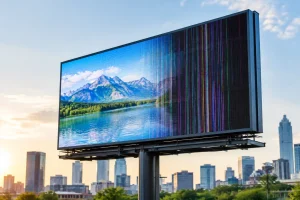
At greater distances, those individual pixels visually blend together. That means a billboard facing a main road or a large external wall display in a business park does not usually need the same pixel density as an indoor boardroom screen.
A useful rule of thumb is to think about the nearest typical viewer, not the furthest. Buyers sometimes focus on how the screen looks from across a car park or dual carriageway, but if pedestrians, customers or visitors also pass underneath or alongside it, that closer viewpoint matters. Good system design accounts for the real mix of viewing positions rather than a single idealised distance.
Content should shape the specification
Not all content places the same demand on the screen. Large-format advertising creative with bold imagery and short headlines is generally more forgiving than detailed dashboards, small text, menus or wayfinding information.
If your display is mainly for brand advertising, promotional loops or simple motion graphics, you may be able to use a wider pitch without compromising effectiveness. If the screen needs to show pricing, schedules, dense messaging or content viewed for longer periods, a tighter pitch becomes more important.
This is one of the most common trade-offs in commercial projects. A client may begin by assuming they need the highest resolution available, but once the content strategy is reviewed, it becomes clear that a more cost-effective pitch will still deliver excellent impact.
Indoor and outdoor LED pixel pitch are not the same decision
Indoor environments usually involve shorter viewing distances, more stationary audiences and more frequent close inspection. For that reason, finer pitches are common indoors.
Outdoor screens face a different set of conditions. They are often larger, viewed from further away and designed to perform in changing daylight, weather and traffic conditions. For roadside billboards, retail park displays and large external advertising screens, the best result often comes from balancing suitable pitch with brightness, durability, structural design and maintenance access.
It is also worth remembering that outdoor projects are rarely governed by image clarity alone. Planning constraints, mounting position, sightlines, surrounding architecture and service access all influence the final recommendation. A technically impressive screen is of limited value if it is difficult to maintain or inappropriate for the site.
Why tighter pitch is not always better value
A tighter pixel pitch increases pixel density. That typically means more LEDs, more complex manufacturing and a higher overall cost. In some applications, that investment is justified. In others, it adds cost without improving commercial performance.
For example, if an outdoor advertising screen is viewed primarily from 20 to 80 metres away, paying a premium for a very fine pitch may not generate a noticeable return. The audience will not experience enough extra detail to warrant the uplift. In those cases, a properly specified wider pitch can be the smarter choice – both visually and financially.
Experienced suppliers will normally challenge over-specification rather than simply sell the highest-cost option. That is especially important for organisations managing multiple sites or balancing capital expenditure across a wider estate.
Common mistakes buyers make with LED pixel pitch
One mistake is comparing screens on pixel pitch alone. Resolution matters, but so do brightness levels, cabinet quality, calibration, contrast, refresh performance and how the screen integrates with the site. A poorly built fine-pitch display can still underperform.
Another is judging pitch from a showroom photo or data sheet without considering installation height and audience movement. A screen in a transport setting, for instance, is viewed differently from one in a retail mall or leisure venue. People may be walking past, waiting, driving by or seeing the display at an angle. Those behaviours affect how much detail is actually perceived.
A third mistake is ignoring content management at the specification stage. If the planned content is not designed for the chosen pitch, the screen will never look as effective as it should. Good content and correct pitch should support each other from the outset.
How to choose the right pitch with confidence
The most reliable approach is to begin with the site and the business objective. Ask who needs to see the display, from where, for how long and for what purpose. Is the goal to attract passing attention, sell advertising space, communicate information, modernise the environment or support a mix of uses?
From there, review the likely nearest and average viewing distances, the type of content to be shown and the practical conditions around the installation. That includes ambient light, exposure, screen size, structural requirements and service access. Once those factors are clear, pixel pitch becomes easier to assess in context rather than as a standalone number.
This consultative process is often where a bespoke manufacturer adds real value. Rather than forcing a standard product into an awkward setting, the specification can be developed around what the site genuinely needs. That usually leads to a better long-term result and fewer compromises after installation.
A guide to LED pixel pitch that supports better buying decisions
If there is one principle worth keeping in mind, it is this: pixel pitch should be appropriate, not extreme. The best choice is the one that delivers clear viewing for the intended audience, supports the right type of content and stays aligned with the project budget.
For some sites, that will mean a fine pitch and close-range detail. For others, a wider pitch will provide exactly the right performance with better overall value. The difference comes down to thoughtful assessment, not guesswork.
With more than 45 years in the sector, LEDsynergy Billboards has seen how much easier projects run when technical decisions are grounded in real operating conditions. When the screen is specified properly from the start, everything that follows – from installation to day-to-day performance – tends to work as it should.
If you are weighing up options for a new digital billboard or display screen, treat pixel pitch as part of the full picture rather than the headline alone. The right answer is usually the one that fits the site quietly, performs reliably and keeps doing the job well long after the launch day excitement has passed.

I would recommend LED Synergy to anyone considering purchasing an LED sign. We have had so many compliments since it was installed and it has been a valuable asset.
Tom Hughes
OSI Food Solutions