
LED Billboard Warranty Coverage Explained
A digital billboard can look impressive on day one and still become an expensive problem if the support behind it is weak. That is why LED billboard warranty coverage matters just as much as pixel pitch, brightness or cabinet design. For most buyers, the real question is not whether a screen comes with a warranty, but what that warranty actually protects when the display is working hard in a live commercial environment.
For property operators, transport sites, leisure venues and retail estates, downtime has a cost. Lost advertising revenue, poor visitor experience, maintenance callouts and internal pressure all arrive quickly when a screen fails. A warranty should reduce that risk. It should not create another layer of uncertainty.
What LED billboard warranty coverage should really mean
A proper warranty is more than a line in a proposal saying a screen is covered for three or five years. It should set out what parts are included, what level of support is available, how faults are assessed, and what happens if performance drops below the agreed standard.
In practical terms, LED billboard warranty coverage often applies to core hardware such as LED modules, power supplies, receiving cards, control systems and cabinet components. On some projects it may also include workmanship, depending on how the supplier structures design, manufacture and installation. That distinction matters. If one company supplies the screen and another installs it, responsibility can become blurred very quickly when faults appear.
For buyers, the strongest position is usually an end-to-end arrangement where the same specialist is accountable for design, manufacture, installation and post-installation support. It keeps ownership clear and makes fault resolution far more straightforward.
Not all warranties protect you in the same way
Two warranties may look similar on paper and still offer very different levels of protection. One may cover replacement parts only, while another includes diagnosis, labour and technical support. One may offer a rapid response for critical failures, while another simply promises to dispatch parts when available.
This is where procurement teams and facilities managers need to look past the headline term. A five-year warranty is not automatically better than a three-year warranty if the longer term comes with broad exclusions, slow response times or limited accountability. Equally, a shorter warranty from an experienced UK specialist with dependable support can represent lower operational risk than a longer policy tied to overseas-only parts supply.
The sensible approach is to judge warranty coverage on substance rather than duration alone.
Parts cover versus parts and labour
This is one of the first points worth clarifying. Parts-only cover means failed components may be replaced under warranty, but site attendance, diagnostics, access equipment and labour can still sit with the client. On a high-level billboard or a busy public venue, those costs can be significant.
Parts and labour cover is often more valuable because it reflects the real cost of keeping the screen operational. Even here, there can be limits. Some warranties cover labour during standard working hours but not out-of-hours attendance. Others cover workshop repair but not on-site intervention. The detail matters.
Return-to-base versus on-site support
Smaller indoor displays are sometimes handled on a return-to-base basis, but large outdoor billboards are different. Removing and transporting major components is not always practical, especially where the display forms part of a revenue-generating advertising asset.
For that reason, on-site support is usually a better fit for commercial LED billboards. It shortens disruption and avoids disputes about who is responsible for access, removal and reinstatement.
Common inclusions and exclusions to check
A dependable supplier should be open about what sits inside the warranty and what falls outside it. If the language is vague, that is a warning sign.
Most warranties will cover manufacturing defects and component failure under normal operating conditions. They may also cover excessive dead pixels, brightness inconsistency or faults in the control system, but only where these meet a defined failure threshold. It is worth asking how those thresholds are measured.
Exclusions often include accidental damage, vandalism, power surges, water ingress caused by external interference, unauthorised repairs and poor-quality third-party modifications. Environmental issues can also appear in the small print. If a screen is installed in a coastal, high-wind or pollution-heavy location, the specification and warranty should reflect that from the outset.
This is where bespoke engineering helps. A screen designed for its actual site conditions is less likely to fall into the grey area where a supplier claims the environment caused the issue and the client argues the product was not suitable in the first place.
Why installation quality affects warranty value
A warranty is only as strong as the installation behind it. Even high-quality LED hardware can suffer premature faults if it is mounted poorly, ventilated badly, connected incorrectly or commissioned without proper testing.
That is why experienced buyers look at warranty coverage and project delivery together. A supplier that carries out site survey, structural coordination, installation and commissioning is in a better position to stand behind the finished system. It also reduces the familiar problem of different contractors blaming one another when a fault appears.
Good installation practice supports warranty performance in another way too. It creates a proper baseline. If brightness levels, power loads, connectivity and environmental sealing are all tested and documented at handover, future diagnosis becomes quicker and less subjective.
LED billboard warranty coverage and ongoing maintenance
Warranty and maintenance are related, but they are not the same thing. A warranty deals with covered defects and failures. Maintenance is about protecting performance over time.
This distinction matters because some clients assume the warranty covers all future servicing. In reality, preventative maintenance may sit under a separate support agreement. That can include cleaning, inspections, recalibration, firmware checks and proactive replacement of wear-prone components before they fail.
For outdoor screens in demanding locations, this approach often makes sound commercial sense. A maintenance plan can extend service life, reduce visible issues and support any warranty claim because the display has been looked after correctly. It also gives operators a clear route back to technical support rather than waiting until a small issue becomes a major one.
Questions worth asking before you sign
When comparing suppliers, a few direct questions reveal a great deal. Ask who is responsible for diagnosing faults, whether support is UK-based, what response times apply, and whether access equipment or labour is included. Ask how replacement parts are stocked and whether equivalent parts can be supplied if a product line changes during the warranty term.
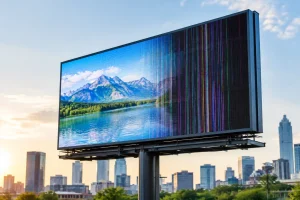
It is also sensible to ask what happens if a fault affects image quality rather than causing total failure. Partial issues can still undermine advertising value. A screen with noticeable colour inconsistency, module mismatch or brightness drop may technically be working, but commercially it is not doing its job properly.
Finally, ask for the warranty terms in writing before approval, not after deposit. Clear paperwork protects both sides and usually reflects a supplier with confidence in its product and service standards.
The supplier relationship matters as much as the paperwork
With digital billboards, buyers are not simply purchasing hardware. They are entering a long-term support relationship. That is why experience, accountability and aftercare should carry serious weight in the decision.
An established specialist with a track record in bespoke commercial LED systems is more likely to understand the realities of operating screens in retail parks, roadside locations, transport environments and leisure venues. They are also more likely to specify the right solution first time, which reduces the chance of disputes later.
This is one reason many organisations favour a consultative UK manufacturer and installer over a low-cost reseller model. When the supplier understands the engineering, the software considerations, the installation environment and the service history, warranty support becomes far more practical and far less theoretical.
A cheaper screen can cost more to own
Price always matters, and any responsible buyer has a budget to work within. But with LED display systems, the cheaper option can become the more expensive one if warranty support is weak, spare parts are slow to arrive or service responsibility is fragmented.
A billboard that fails repeatedly does not just generate repair costs. It can damage advertiser confidence, create operational disruption and consume internal time. When viewed across the full life of the asset, strong warranty coverage and dependable aftersales support often represent better value than a lower initial purchase price.
That is why warranty should be treated as part of the product, not an afterthought attached to it.
For buyers planning a new digital display, the right question is simple: if something goes wrong in year two, three or four, who will take ownership and put it right properly? When the answer is clear, specific and backed by real experience, you are looking at a supplier worth taking seriously.

I would recommend LED Synergy to anyone considering purchasing an LED sign. We have had so many compliments since it was installed and it has been a valuable asset.
Tom Hughes
OSI Food Solutions