
LED Screen Site Survey: What Really Matters
A screen can look perfect on a drawing and still be wrong for the site. We see it regularly – a wall that appears suitable but cannot take the load, a viewing angle blocked by trees or street furniture, or a power supply that looks straightforward until the available capacity is checked. That is why an LED screen site survey is not a box-ticking exercise. It is the stage that protects the investment and gives everyone involved a clearer route from concept to installation.
For buyers responsible for commercial property, retail environments, leisure venues or transport locations, the survey is where practical reality meets commercial ambition. It helps answer the questions that matter early: will the screen be seen properly, will it perform reliably, what enabling works are needed, and what is the most cost-effective way to deliver the right result first time.
Why an LED screen site survey matters
A digital display project has more moving parts than many people expect. The screen itself is only one part of the overall system. Fixings, structural support, access for installation, wind loading, ambient light, power, data connectivity, maintenance access and local planning constraints all influence what can be installed and how well it will work.
A proper LED screen site survey reduces the chance of expensive changes later. It also helps avoid under-specifying or over-specifying the solution. In some locations, a finer pixel pitch may be justified because audiences are close to the display. In others, spending more on resolution brings little benefit because typical viewing distances are much greater. The same applies to brightness, screen size, cabinet type and access strategy. What works for a shopping centre entrance may be completely wrong for a roadside billboard.
This is where experience makes a difference. A survey should not only identify risks. It should shape a better solution.
What a good site survey should assess
The first priority is always the site itself. That means understanding exactly where the screen will sit, what the audience will see, and what conditions the display will need to handle day after day. For an outdoor installation, that includes weather exposure, prevailing conditions and how nearby buildings affect visibility and light levels. For indoor sites, ceiling heights, reflected light, traffic flow and viewing dwell time often matter more than people first assume.
Structural suitability is another critical area. A survey needs to establish whether the proposed mounting surface or support steel can safely carry the screen and its associated loads. The screen weight is only part of that calculation. Wind loading, maintenance access and long-term durability all need to be considered. If additional steelwork or a bespoke support frame is needed, it is far better to identify that before a project is priced and scheduled.
Power and communications should also be looked at in practical detail. It is not enough to know that power exists somewhere on site. The survey should confirm where it is, what capacity is available, the cable route, isolation arrangements and whether upgrades may be required. Connectivity needs the same level of care. Some sites are well suited to hardwired network connections, while others may be better served by 4G or another managed option. It depends on location, content requirements and how the display will be operated.
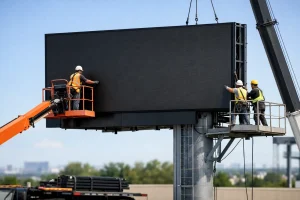
Then there is access. This is often underestimated. Installers may need a cherry picker, scaffold, lifting equipment or traffic management depending on the screen position. Even simple questions such as where a vehicle can park or whether equipment can pass through a service yard can affect cost and programme. A site survey should make those practicalities clear from the outset.
Visibility is not just about screen size
Many buyers begin with a size in mind, which is understandable. Bigger often feels safer. But visibility is a combination of size, positioning, height, pixel pitch, brightness and surrounding competition for attention.
A well-run survey will consider approach routes, sight lines and audience behaviour. Is the display targeting drivers, pedestrians or both? Are viewers passing quickly, or standing within close range? Is there competing signage nearby? Does the screen need to work in direct sunlight, low light, or both? These questions influence the technical specification far more than headline dimensions alone.
There are trade-offs here. A larger screen in a compromised position may perform worse than a slightly smaller screen placed correctly. Likewise, very high brightness can be useful in exposed outdoor settings, but it still needs to be balanced with local conditions, control systems and operating requirements.
Site surveys help control the real project cost
Procurement teams are often asked to compare like-for-like quotes, but LED display projects are rarely that simple. If one supplier has priced from a rough description and another has surveyed the site properly, those figures may not be comparable at all.
A thorough survey improves cost certainty. It brings likely enabling works into view, highlights access requirements, identifies any electrical upgrades and clarifies whether bespoke fabrication is needed. That means fewer surprises once an order is placed.
It can also save money by avoiding unnecessary specification. Not every site needs the highest brightness, the finest pitch or the most complex support arrangement. A consultative survey should filter out what is not needed as well as flagging what is essential. For commercial buyers, that balance matters. The aim is not simply to install a screen. It is to install the right screen for the site, budget and business objective.
What happens during an LED screen site survey
A professional survey usually starts with a discussion about the project goal. That might be advertising revenue, improved wayfinding, customer engagement, tenant communications or a broader site upgrade. Understanding that purpose helps frame the technical decisions.
From there, the surveyor will assess the proposed location in detail. Measurements are taken, photographs recorded and key services reviewed. Structural mounting options are examined, likely cable routes are noted, and potential installation constraints are identified. Depending on the site, planning considerations, operating hours, public safety and maintenance access may also need to be discussed.
In more complex projects, a survey may lead to follow-on actions such as structural calculations, traffic management planning or coordination with other contractors. That is not a sign of complication for its own sake. It is part of doing the job properly. The more demanding the site, the more valuable that groundwork becomes.
Indoor and outdoor surveys are not the same
The phrase site survey covers a lot of ground, but indoor and outdoor environments present different priorities.
Outdoor billboard and façade projects tend to place greater emphasis on structural support, weather resistance, sunlight exposure and long-distance visibility. Access equipment, road restrictions and public interface issues are often part of the equation too. If the screen is located near highways or busy urban routes, safe installation planning becomes especially important.
Indoor displays usually involve a different set of questions. How close are viewers to the screen? What does ambient lighting do to perceived image quality? Will the display need to integrate with existing interior finishes or fit within an architectural feature? Is there enough ventilation around the installation area? In shopping centres, corporate settings and leisure venues, aesthetics and service access often need equal attention.
Why bespoke projects depend on proper surveying
Bespoke LED display systems are rarely chosen because the site is simple. They are chosen because the screen needs to do a specific job in a specific environment. That might mean fitting a non-standard structure, meeting operational constraints, or creating a display that aligns with a property’s branding and commercial goals.
Without a proper survey, bespoke becomes guesswork. With a proper survey, bespoke becomes controlled and practical.
This is one of the reasons experienced manufacturers and installers put so much emphasis on early-stage assessment. A good survey informs not only the installation plan, but the design, cabinet selection, service strategy and content considerations as well. At LEDsynergy Billboards, that front-end diligence is part of delivering systems that are built for the real world rather than the sales drawing.
Choosing a supplier that takes surveying seriously
If you are comparing providers, ask how they approach site surveys and what they are looking to establish. A serious answer should cover structural considerations, electrical requirements, connectivity, access, visibility and maintenance. It should also reflect an understanding of your commercial objective, not just the hardware.
Be cautious of suppliers who can provide a fixed recommendation before they understand the site properly. Sometimes a quick desktop indication is possible, but confident decisions require evidence. An experienced specialist should be transparent about what is known, what still needs to be confirmed and where the key variables sit.
That level of honesty is valuable. It builds trust and usually leads to a better project outcome.
A worthwhile LED screen project starts long before installation day. The survey stage is where risk is reduced, sensible decisions are made and the groundwork for reliable performance is set. If you want a display that looks right, works hard and stands up to daily use, the best place to start is with a proper look at the site itself.


I would recommend LED Synergy to anyone considering purchasing an LED sign. We have had so many compliments since it was installed and it has been a valuable asset.
Tom Hughes
OSI Food Solutions