
Common LED Billboard Installation Mistakes
A digital billboard can look impressive in a specification document yet underperform from its first day on site. Most common LED billboard installation mistakes are not caused by the screen itself. They arise when site conditions, structural requirements, viewing distances, power provision and ongoing access are treated as details to resolve later.
For property operators, facilities managers and marketing teams, the result can be delayed opening dates, avoidable remedial costs and a display that does not deliver the visibility or advertising return expected. A properly planned installation protects the investment before the first LED module is fitted.
Common LED Billboard Installation Mistakes to Avoid
Choosing pixel pitch before assessing the audience
Pixel pitch is often discussed as though a smaller number is automatically better. It is not. The correct pitch depends on how close people will stand to the display, how quickly they pass it, the size of the content and the commercial role of the screen.
A large roadside billboard viewed from significant distance does not necessarily need the same fine pitch as a display in a shopping centre entrance. Specifying too fine a pitch can increase capital cost and power demand without creating a noticeable benefit for the audience. Conversely, a coarse pitch used too close to pedestrian traffic can leave text and imagery looking less refined than intended.
Start with the real viewing conditions: minimum and typical viewing distance, approach angles, dwell time, ambient light and whether the audience is walking, driving or waiting. This makes it possible to specify a screen that looks right in use, rather than one that simply appears impressive on paper.
Skipping a thorough site survey
A site survey is where assumptions meet reality. Building finishes may conceal steelwork, service routes can differ from drawings, and a proposed location can have restricted access for lifting equipment. Even small discrepancies can affect the mounting design, installation sequence and programme.
For an outdoor screen, the survey should consider wind exposure, ground conditions, drainage, access routes and the position of nearby buildings or trees. For indoor installations, it should establish ceiling loading, fire routes, existing services, public circulation and how the screen will be brought into the building.
It is also the right time to identify practical issues that may otherwise be missed, such as a narrow delivery entrance, a requirement for out-of-hours works, or the need to protect a busy public area during installation. A clear survey report gives every party a shared understanding of the work before manufacture and site mobilisation begin.
Treating the support structure as an afterthought
An LED billboard is only as dependable as the structure supporting it. The screen weight is one consideration, but it is not the only one. Wind loading, fixing points, vibration, maintenance access and the condition of the host building or freestanding foundation all matter.
Outdoor installations require properly engineered calculations appropriate to the location and screen area. A display installed on an exposed elevation or in an open car park can be subject to considerably different forces from one positioned within a sheltered retail development. The mounting frame must distribute loads correctly and allow for the tolerances required to create a flat, aligned display face.
Trying to adapt an unsuitable existing frame can appear economical at first. In practice, it may introduce delays, compromise access or create a more expensive remedial project later. Bespoke steelwork and mounting arrangements are often the sensible route where a site has particular constraints.
Underestimating power, data and connectivity requirements
A digital billboard needs more than a convenient electrical outlet. Its supply must be sized for the display, associated control equipment and likely operating conditions, with suitable protection and isolation. Peak power requirements, cable routes, containment and the location of distribution equipment should all be agreed early.
Data connectivity deserves the same attention. Content management, remote monitoring and software updates rely on a reliable connection. In some locations, a hardwired connection is straightforward; in others, managed wireless or mobile connectivity may be more practical. The right choice depends on signal quality, network security, site ownership and the level of control required by the client.
The avoidable mistake is leaving these decisions until the screen is ready to commission. Early coordination with the building’s electrical contractor and IT team helps prevent last-minute cable runs, inadequate capacity or access issues with secure networks.
Forgetting heat, weather and environmental conditions
Outdoor LED technology is designed to operate in demanding conditions, but the installation must support that capability. Water management, cable glands, sealing, ventilation and protection from direct environmental exposure must be addressed as part of the overall design. Water entering poorly finished connections or standing around a base structure will not improve with time.
Heat is equally relevant. Screens generate heat, and enclosed or semi-enclosed locations need sufficient airflow and appropriate thermal management. A display positioned beneath a canopy, within a feature wall or against a façade may require a different arrangement from an open-fronted billboard.
For indoor screens, dust, kitchen vapours, humidity and high-traffic environments can influence the preferred enclosure, service arrangement and cleaning regime. There is no single specification that suits every venue. The screen and its installation should reflect the conditions it will face every day.
Ignoring sightlines and daylight performance
A billboard can be technically sound and still fail its commercial purpose if it is poorly positioned. Obstructions, vehicle queuing patterns, pedestrian routes, street furniture and the angle of approach all influence whether people actually see the message.
Sightline planning should assess the display from the audience’s point of view, not solely from the proposed mounting location. A screen mounted too high may be missed by pedestrians. One placed too low can be obscured by parked vehicles, railings or crowds. At roadside locations, the message needs to be legible within the available viewing time without creating distraction or compromising safety.
Brightness settings also need to suit the environment. A screen must remain clear in bright daylight, while automatic dimming helps it remain comfortable and appropriate after dark. Excessive brightness can create complaints, waste energy and make content look harsh. Insufficient brightness can leave a premium advertising asset ineffective when it matters most.
Compliance Is Part of the Installation, Not Paperwork Afterwards
Planning permission, advertising consent, building regulations, landlord approval and highway considerations can all affect a digital billboard project. Requirements vary by location, size, orientation, operating hours and proximity to roads or residential properties. Listed buildings, conservation areas and transport environments may introduce further restrictions.
The best approach is to establish the approvals pathway at the feasibility stage. This helps shape the screen size, location, brightness controls and content operating policy before significant commitments are made. It also gives project teams time to prepare the technical information that planning authorities, landlords or asset managers may require.
Health and safety planning should be equally practical. Installation teams need suitable lifting plans, work-at-height controls, traffic or pedestrian management where necessary, and a clear method for protecting the public and site staff. These are not administrative extras. They are fundamental to delivering work properly and keeping a live venue operational.
Do Not Design Out Future Maintenance
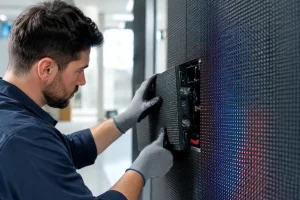
A common error is focusing entirely on the finished front face of the display. LED billboards require sensible access for inspection, cleaning, module replacement and technical servicing. If an engineer cannot safely reach the rear of a screen, remove a panel or access control equipment, routine support becomes unnecessarily difficult and costly.
Front-serviceable systems can be an effective answer where rear access is restricted, but they must still be designed around the available working space. Freestanding signs may need access doors or platforms. Façade-mounted displays may require a planned means of reaching the installation without disrupting tenants or public areas.
Consider how the site will operate after handover. Who controls content? Who receives fault notifications? Is there a safe isolation point? Are spare parts, warranty arrangements and service response procedures understood? These questions protect uptime and make responsibilities clear.
Rushing Commissioning and Content Testing
Commissioning is the point at which the physical installation becomes a working communication asset. It should include checks of screen alignment, electrical performance, data connection, brightness controls, scheduling, remote access and monitoring. It should also confirm that the display presents content correctly at the chosen resolution and aspect ratio.
Content testing is particularly valuable. A creative that works on a desktop monitor may not read well on a large-format screen viewed at speed. Small type, low contrast, overly detailed imagery and unsuitable animation can weaken a campaign. Testing representative content from the actual viewing positions gives marketing teams a realistic basis for adapting artwork.
A considered handover should leave the client confident, not dependent on guesswork. Training, operating guidance and a known support contact make a substantial difference in the first weeks of operation.
At LEDsynergy Billboards, we approach each project as a complete installation rather than a screen delivery. The right survey, specification and commissioning process may take more care at the outset, but it is the practical way to achieve a dependable display that earns its place on site for years to come.

I would recommend LED Synergy to anyone considering purchasing an LED sign. We have had so many compliments since it was installed and it has been a valuable asset.
Tom Hughes
OSI Food Solutions