
Best LED Screens for Shopping Centres
A shopping centre screen has only a moment to do its job. It needs to catch attention in a bright, busy environment, stay readable from the right distance, and keep performing day after day with minimal fuss. That is why choosing the best LED screens for shopping centres is rarely about picking the biggest panel or the lowest price. It is about selecting the right screen for the location, the audience and the commercial purpose.
For centre managers, property teams and retail marketing leads, that decision usually sits at the junction of footfall, revenue and operational reliability. A well-specified LED display can strengthen wayfinding, support centre-wide campaigns, improve the feel of an entrance or atrium, and create a genuine media asset for third-party advertising. A poorly specified one can look washed out, feel intrusive, or become a maintenance issue that nobody wanted.
What makes the best LED screens for shopping centres?
The short answer is suitability. In shopping centres, one screen type does not fit every setting. An external roadside or entrance-facing screen has different demands from an indoor promotional wall, and both differ again from a suspended feature display in an atrium.
The best systems are chosen around viewing distance, ambient light, content type, dwell time and access for maintenance. If the main purpose is short, high-impact brand messaging at a distance, a larger pixel pitch may be perfectly appropriate and more cost-effective. If the display is close to passing shoppers and expected to show fine text, directional information or detailed retail creative, a finer pitch becomes much more important.
Reliability also matters more than many buyers first expect. Shopping centres are live environments with tenants, visitors and trading hours to protect. If a screen goes down, it is not just a technical issue. It reflects on the venue and can disrupt advertising commitments. That is why build quality, service support and sensible system design should sit alongside image quality in any purchasing decision.
The main screen types used in shopping centres
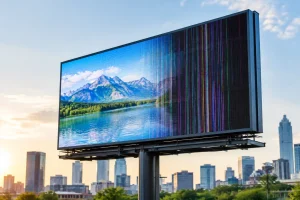
Outdoor LED screens are often the first point of contact. These are typically used at main entrances, on building elevations or in car park approaches where centres want to promote offers, events or paid advertising. Here, brightness, weather resistance and structural suitability are central. The display needs to remain visible in changing daylight while standing up to the British climate.
Indoor LED screens tend to be more varied. Some are straightforward promotional walls placed near anchor tenants or high-footfall routes. Others are built into feature areas, food courts or event spaces where the display becomes part of the atmosphere as well as a messaging tool. Fine pixel pitch is more common indoors because viewers are closer, but there is still a balance to strike. Overspecifying a screen can add cost without adding meaningful benefit.
Large-format media walls have become especially popular in modern centres looking to create premium advertising inventory. These installations can command attention and help reposition a venue, but they need careful planning. The larger the screen, the more important it is to consider sightlines, content management and how the display sits within the architecture rather than fighting against it.
Transparent LED and specialist creative formats can also suit certain schemes, especially where design sensitivity is high. They can work well in glazed areas or where planners and landlords want visual impact without fully blocking light or views. They are not the answer everywhere, but in the right setting they can be an effective compromise between digital communication and architectural intent.
Brightness, pixel pitch and viewing distance
These are three of the biggest factors behind a successful project, and they are closely linked. Brightness should match the environment. External screens need enough output to cope with daylight, while indoor screens need to be bright enough to stand out without becoming uncomfortable or overbearing.
Pixel pitch is often the first specification buyers are shown, but it only matters in context. A finer pitch gives a sharper image at close range, though it also increases cost. In a shopping centre, the right answer depends on how near people will be to the screen and what they are expected to read or take in. A dramatic promotional visual viewed from across an atrium has different requirements from an information-led display placed beside escalators.
Viewing distance brings those decisions together. A screen can look excellent in a showroom and be wrong for the real site if the practical viewing conditions have not been considered. This is one reason a proper site survey matters. The best result comes from designing around the space, not forcing a standard product into it.
Best LED screens for shopping centres by location
At the entrance, high-brightness outdoor LED screens usually make the most sense. They help centres communicate before visitors even walk in, and they are effective for event promotion, brand campaigns and seasonal messaging. These displays need strong environmental protection and careful positioning to avoid glare or wasted visibility.
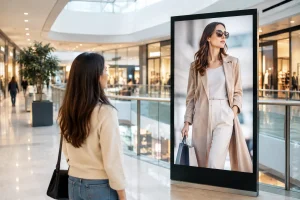
In malls and circulation routes, indoor direct-view LED often provides the best balance of impact and flexibility. It works particularly well for retail promotions, centre announcements and sponsored advertising where there is heavy passing traffic and short dwell time. Here, image quality at medium viewing distances is usually more important than chasing the finest available pitch.
In atriums and feature zones, larger statement displays can earn their keep if the commercial model supports them. These are often the screens people remember, but they only work when content is well managed and the display has been integrated properly into the building. A large screen with weak content quickly becomes background noise.
For food courts and leisure areas, the brief can shift slightly. Visitors tend to dwell longer, so content can be more layered and scheduling can be more varied. These screens may support branding, entertainment, event schedules or advertising packages, but they still need to be durable and easy to operate.
The commercial case matters as much as the screen
The best LED screen for a shopping centre is not always the one with the most impressive specification sheet. It is the one that supports a clear business case. For some venues, that means increasing advertising revenue. For others, it means improving tenant communications, modernising the visitor experience or strengthening the centre brand.
This is where a consultative approach pays off. If a screen is being bought purely on unit price, key costs often appear later in structure, access, control systems or maintenance. A better route is to assess the full project from the start, including installation, software requirements, power, connectivity and future servicing. That tends to produce a more cost-effective result over the life of the display, even if the headline purchase price is not the cheapest.
There is also a content question that should not be ignored. LED is powerful, but only when the content strategy matches the environment. Centres using screens for mixed purposes, such as paid media, centre messaging and live campaigns, need a sensible playback and scheduling plan. The technology should support that, not complicate it.
What buyers should look for in a supplier
Experience in public-facing commercial environments counts. Shopping centres are not simple installations, and they demand a supplier who understands surveying, structural considerations, commissioning and aftercare as part of one joined-up service. The best projects are usually delivered by specialists who ask practical questions early and deal with issues before they become expensive.
British manufacturing and tailored design can also be valuable advantages, particularly where sites have unusual dimensions, specific compliance requirements or demanding operating conditions. Bespoke systems are often a better fit than trying to adapt a generic import to a complex retail environment.
Support after installation should be part of the buying decision, not an afterthought. Centre teams need confidence that if there is an issue, they can get a clear answer quickly. For many clients, that reassurance is worth a great deal because it reduces risk and protects trading operations. At LEDsynergy Billboards, that practical, end-to-end mindset is central to getting solutions right first time.
Common mistakes to avoid
One common mistake is choosing a screen based on size alone. Bigger can be better, but only if the location, content and sightlines justify it. Another is overspending on ultra-fine pixel pitch where the viewing distance does not require it.
Buyers also sometimes underestimate maintenance access. A screen may look ideal on paper, but if servicing it causes disruption or specialist access costs every time, ownership becomes more complicated than expected. Equally, indoor and outdoor ratings should never be blurred. A screen designed for one environment should not be forced into another to save money.
Perhaps the biggest mistake is treating the screen as a standalone purchase rather than a long-term asset. The strongest results come when the display is planned as part of the centre’s wider commercial and operational strategy.
If you are weighing up the best LED screens for shopping centres, the right starting point is not a catalogue. It is a clear conversation about what the screen needs to achieve, how the space really works and what level of support you expect once it is live. Get those fundamentals right, and the technology becomes far easier to specify with confidence.
I would recommend LED Synergy to anyone considering purchasing an LED sign. We have had so many compliments since it was installed and it has been a valuable asset.
Tom Hughes
OSI Food Solutions