
When to Replace LED Display Modules: Key Signs
A single dark patch on an otherwise bright digital billboard can be easy to dismiss. Yet knowing when to replace LED display modules is often the difference between a straightforward planned repair and a visible fault that undermines advertiser confidence, venue presentation and screen revenue.
For commercial LED displays, modules are the serviceable building blocks behind the image. They are designed to be replaced without changing the entire screen, but replacement should be based on the cause of the issue, the display’s condition and the availability of compatible parts – not simply on the presence of one imperfect pixel.
What an LED display module does
An LED module is the panel section that contains the LEDs, driver electronics and connections responsible for a portion of the image. Multiple modules fit together within the cabinet to create one continuous display surface. If a module fails or performs differently from those around it, the fault can appear as a dark area, a band of incorrect colour, flickering or a visible change in brightness.
This modular construction makes professional LED screens practical to maintain over a long service life. A correctly specified replacement can restore image quality without the cost and disruption of replacing a complete cabinet or screen. However, a module is only one part of a wider system. Power supplies, receiving cards, data cables, environmental sealing and control settings can all produce symptoms that look like a module failure.
That distinction matters. Replacing a working module will not resolve a power or signal problem, and repeated component changes can increase downtime unnecessarily.
When to replace LED display modules
The clearest reason to replace a module is a persistent, localised fault that remains after sensible diagnostic checks. A blank rectangular section, a consistent colour mismatch, clusters of failed LEDs or physical damage to a module are all strong indicators that replacement is appropriate.
A module should also be considered for replacement when it no longer matches the visual performance of the rest of the display. On an advertising screen, uneven brightness or a noticeably different colour temperature can make campaigns look poorly presented, particularly when the content includes large areas of white, skin tones or solid brand colours. What is barely visible on a busy moving image may be obvious during a static advert or after dusk.
Age is relevant, but it is not a replacement trigger on its own. LEDs gradually lose brightness over time, and an older screen may show natural variation across its face. Replacing one module with a brand-new unit can occasionally create a brighter patch rather than a perfect match. The right approach depends on the display’s age, original specification, viewing distance and the condition of neighbouring modules.
Signs that point to a module fault
Some faults are more likely than others to sit within the module itself. These include:
- A clearly defined black or dim rectangular area matching the module size
- A section showing the wrong colour, such as red, green or blue remaining dominant
- Repeated dead pixels or lines confined to one module
- Intermittent flickering in the same section after cables and connections have been checked
- Visible impact damage, water ingress or corrosion affecting the module face or connectors
If the fault shifts, affects several cabinets or occurs across an entire row, the cause may lie elsewhere. A shared power supply, ribbon cable, receiving card or data connection should be investigated before modules are ordered.
Do not judge the screen only from the pavement
The viewing position is commercially important, but it is not enough for diagnosis. A screen may appear uneven at close range while looking entirely acceptable from its intended audience distance. Equally, a small fault can be highly noticeable from across a forecourt, shopping centre atrium or transport concourse when it interrupts a clean graphic.
Assess the display using the content it actually carries. Solid white, red, green and blue test images are useful for identifying colour and brightness differences. Greyscale content can reveal subtle banding. It is also worth checking the screen at different times of day, as a fault that is hidden in bright sunlight may become prominent at night.
For outdoor installations, inspect after wet weather as well as during normal dry operation. Moisture-related faults can be intermittent, and their source may be a compromised gasket, cabinet door seal, cable gland or drainage issue rather than the module itself. Replacing the affected panel without resolving ingress will only repeat the problem.
Check compatibility before ordering replacements
LED modules are not interchangeable simply because they look similar. Pixel pitch, physical dimensions, scan rate, driver IC configuration, HUB layout, brightness, mask design and calibration data can all vary between products. Even modules from the same nominal range may differ between manufacturing batches.
A replacement needs to be compatible with the existing cabinets and control system, while also producing an acceptable visual match. This is particularly important for bespoke billboards, curved screens, 3D displays and installations built around a specific cabinet design. Using an unsuitable module can result in poor colour consistency, unstable operation, image mapping errors or damage to connected components.
Where possible, retain details of the original screen specification, module part numbers, cabinet drawings and commissioning information. A professional supplier can use these records, along with photographs and fault information, to identify the correct route. For legacy screens, exact replacements may no longer be manufactured. In that situation, it may be necessary to use carefully matched stock, replace a larger screen area or consider a phased upgrade.
Decide between one module, a cabinet repair or a wider refresh
Replacing a single module is usually the most cost-effective answer when the display is relatively modern, the fault is isolated and matching spares are available. It keeps disruption low and protects the value of the original investment.
A cabinet-level repair may be more appropriate where several modules show issues, there is evidence of water ingress, or power and data components are nearing the end of their useful life. Treating the cabinet as a whole can prevent a series of call-outs for related faults.
A wider refresh deserves consideration when module faults are becoming regular, image quality is inconsistent across the display, or replacement modules are difficult to source. This does not always mean replacing the full screen immediately. In some cases, upgrading a defined section, renewing ageing electronics or planning replacement around a future advertising cycle provides a more sensible commercial outcome.
The decision should account for downtime as well as component cost. A screen generating advertising income, supporting passenger information or directing visitors around a site carries a cost whenever it is unavailable. Planned maintenance during quieter trading periods is generally preferable to waiting for a visible failure.
Protect the new module with the right installation practice
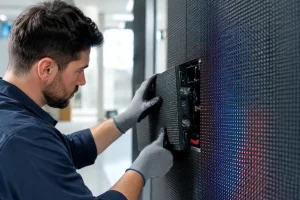
Module replacement is not simply a case of removing a panel and fitting another. Screens should be isolated safely, with work carried out by competent personnel who understand the cabinet layout, electrical arrangements and access requirements. Outdoor and high-level displays may also require controlled access equipment, traffic management or out-of-hours working.
Once fitted, the replacement should be checked for secure connections, correct image mapping, brightness, colour balance and weather sealing where relevant. The surrounding modules should be inspected at the same time. A loose data cable or deteriorating gasket found early can prevent a second visit and avoidable screen downtime.
For a high-value commercial display, it is sensible to keep a small number of approved spare modules where the screen specification and storage conditions allow. This is particularly valuable for remote sites, busy transport locations and displays supporting contracted advertising campaigns. Spares should be labelled clearly and stored in a clean, dry environment so they remain usable when required.
A practical maintenance approach for commercial screens
The most reliable displays are not those that never need attention. They are the displays supported by a clear maintenance plan, accurate system records and prompt action when image quality changes.
Routine visual checks can be carried out by site teams, while technical inspections should look more closely at cabinets, cooling, power supplies, connections, seals and control hardware. Recording faults with photographs, screen location, time of occurrence and content being shown helps engineers identify patterns quickly. It also makes it easier to distinguish an isolated module issue from a developing system fault.
LEDsynergy Billboards approaches maintenance with the same care applied at design and installation stage: identify the real cause, specify the right component and complete the work properly. That is particularly valuable where a display is bespoke, revenue-generating or located in a demanding public environment.
A small image defect rarely improves by itself. Address it early, verify the cause and plan the repair around your site operations. Your audience may never notice the maintenance work, but they will notice a screen that continues to look sharp, dependable and ready for every campaign.


I would recommend LED Synergy to anyone considering purchasing an LED sign. We have had so many compliments since it was installed and it has been a valuable asset.
Tom Hughes
OSI Food Solutions